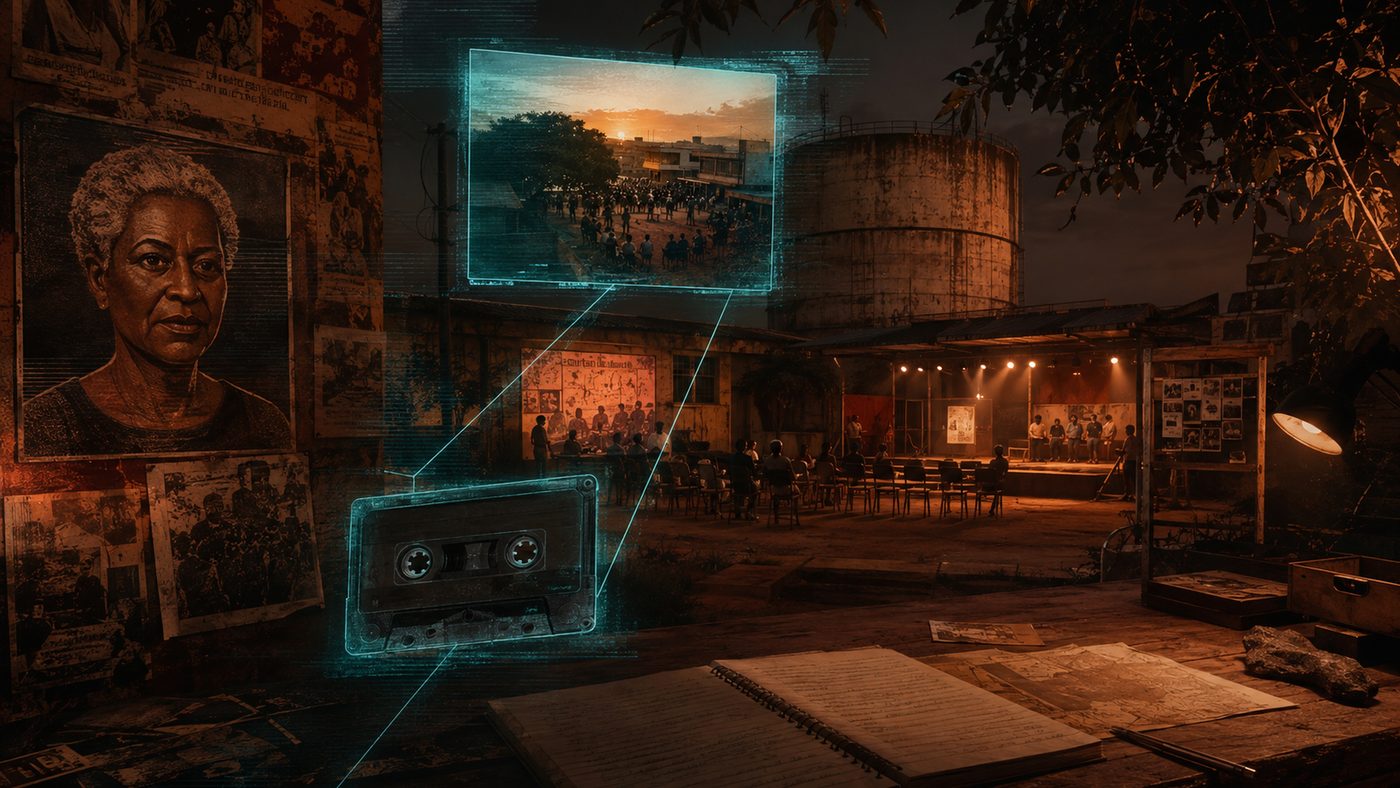
“O passado não é cenário. É evidência em disputa.”
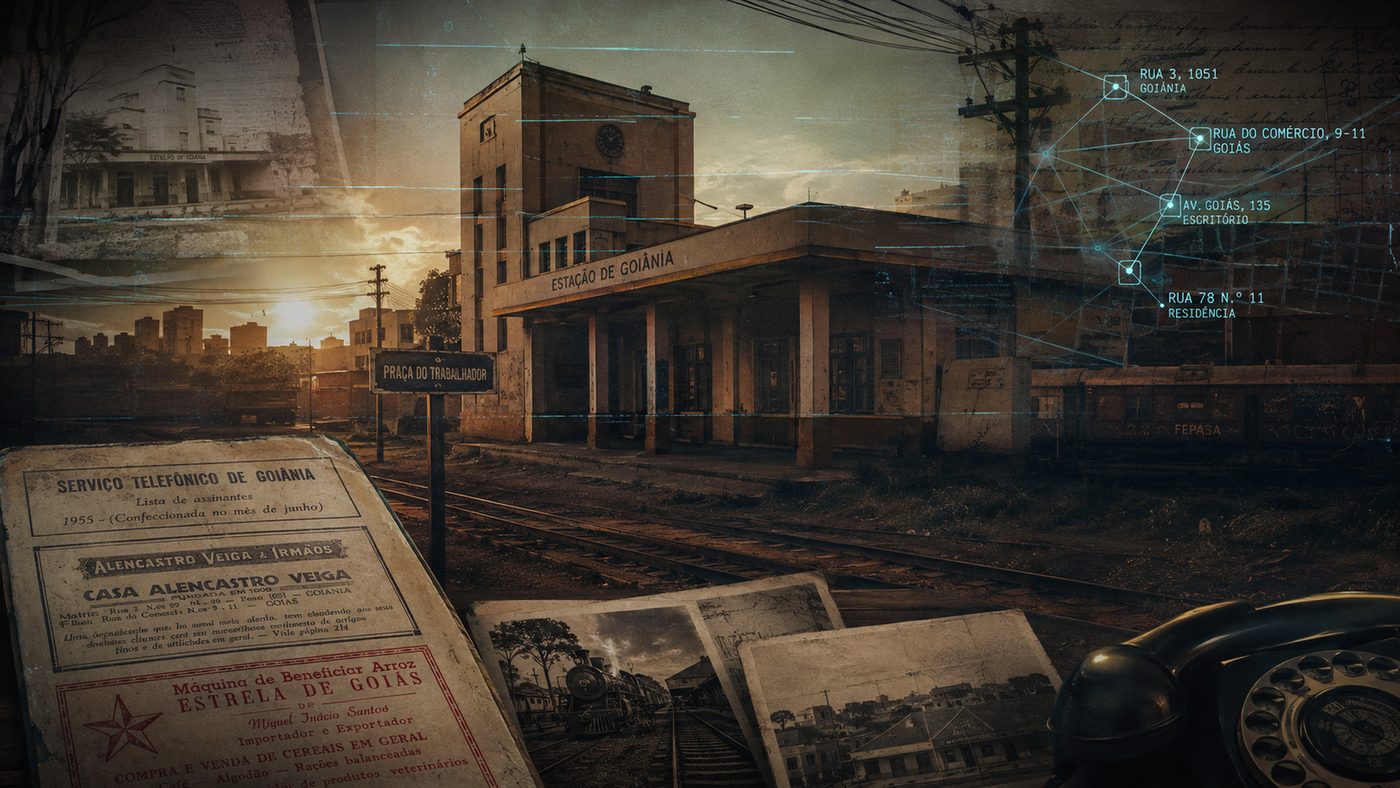
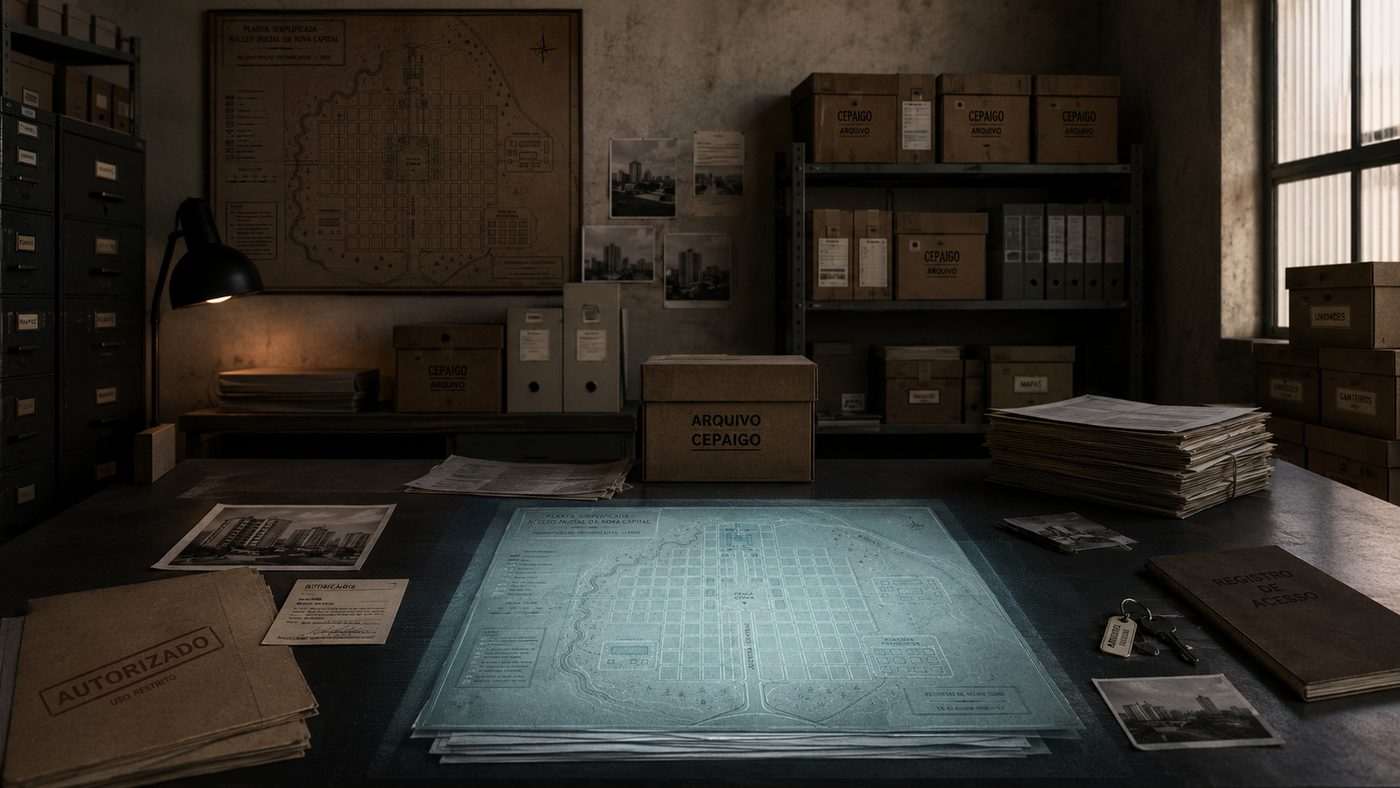
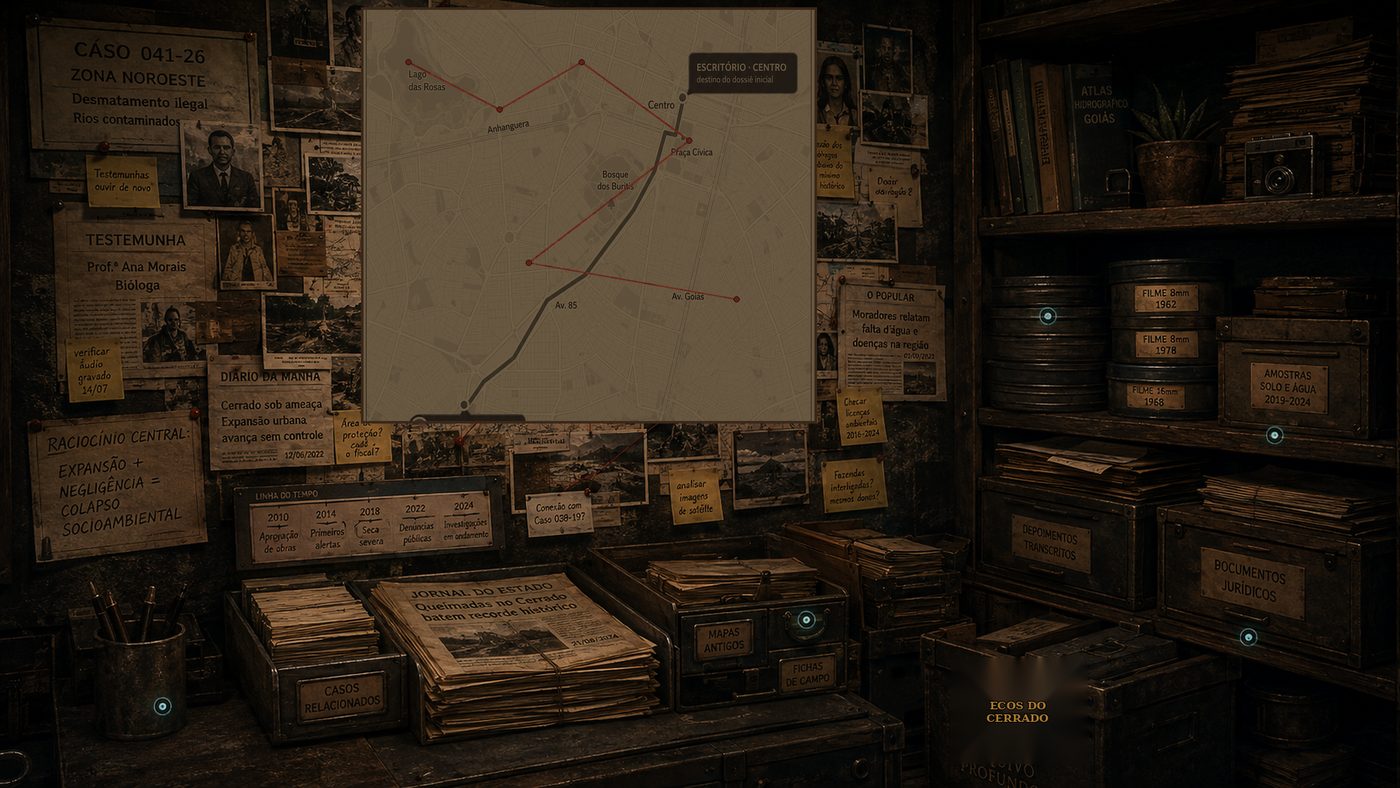
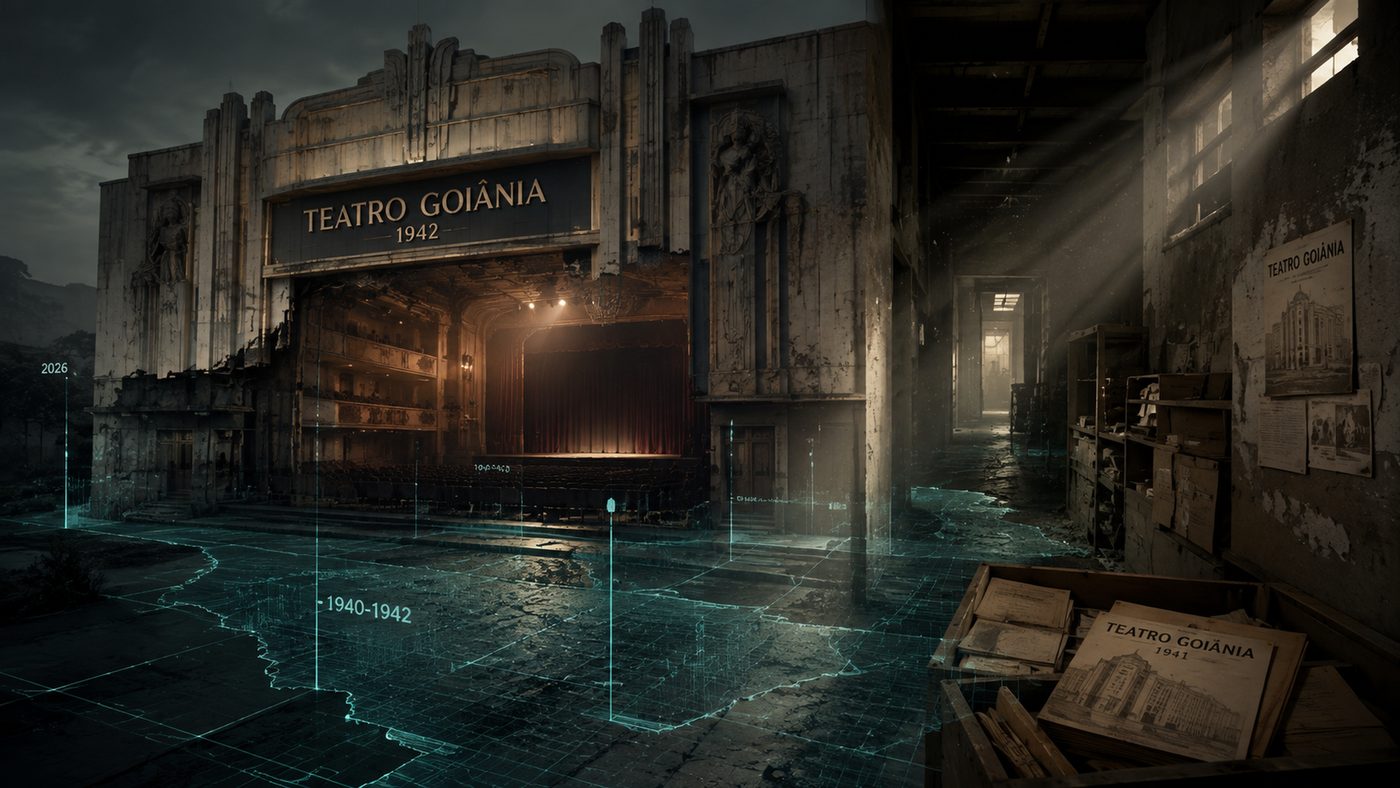
Ecos do Cerrado é um jogo brasileiro de investigação narrativa ambientado em Goiânia, Goiás. Em 2026, o jogador investiga documentos, fotografias, mapas, depoimentos, arquitetura e objetos para reconstruir relações entre memória, território e evidência. O passado surge por meio de reconstruções documentais — não há viagem no tempo.
“Investigue. Cruze evidências. Formule sua hipótese.”
Examine documentos, mapas, fotografias e depoimentos. Cruze contradições, conecte evidências e formule sua própria hipótese sobre o que aconteceu.
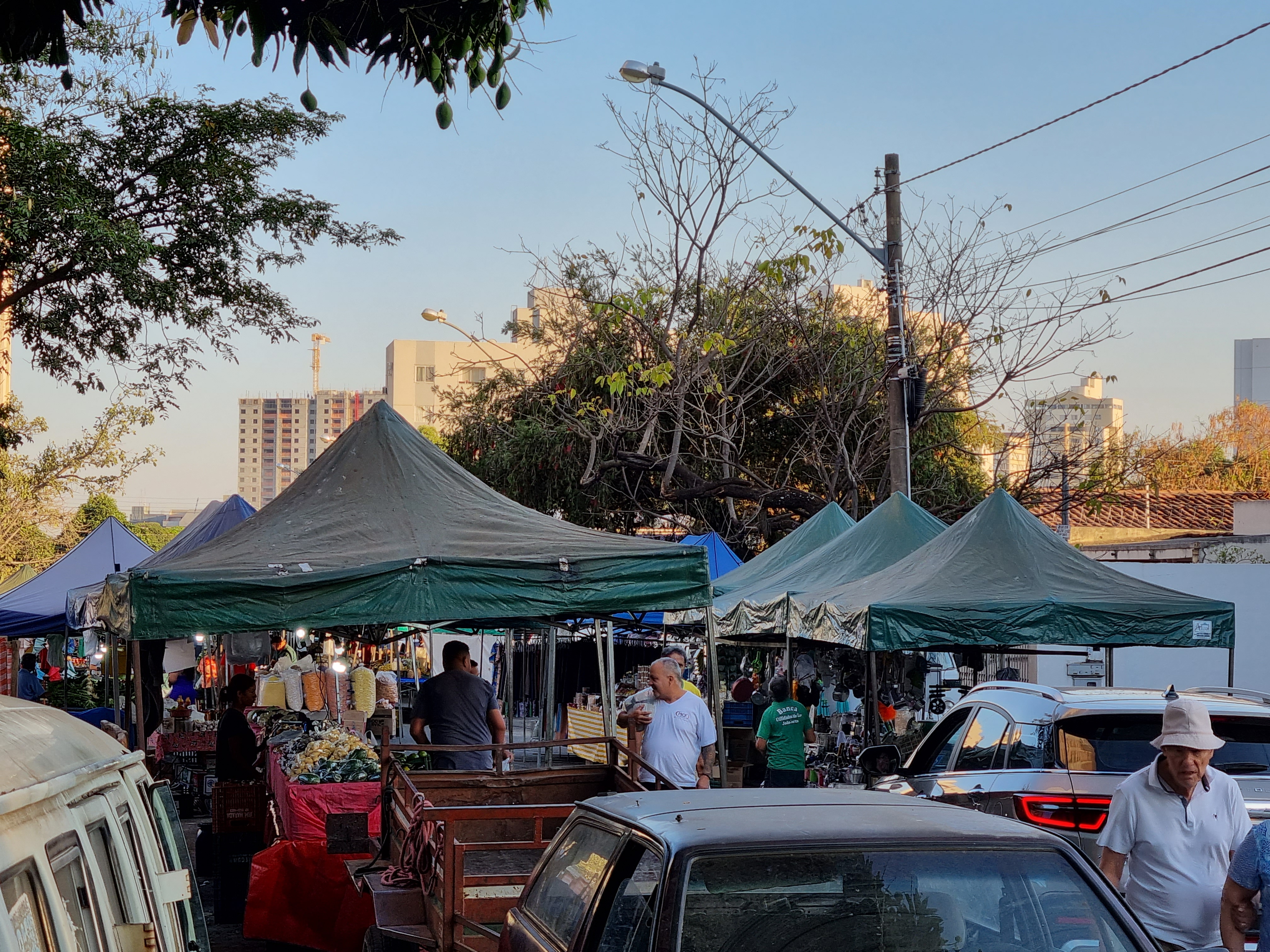
Ambiente de investigação — Goiânia, 2026
Acompanhe o desenvolvimento
bottom of page
N.'s Notebook
Goiânia · August 2026 · personal notes
Note to self. I have little use for conclusions that arrive before the material. I leave the order of things here before someone decides to arrange them for me.
Aug 30, 2026 · 19:00
When the Façades Light Up
Visual reference: Fronteira · October 2023 · CC BY-SA 4.0 · source
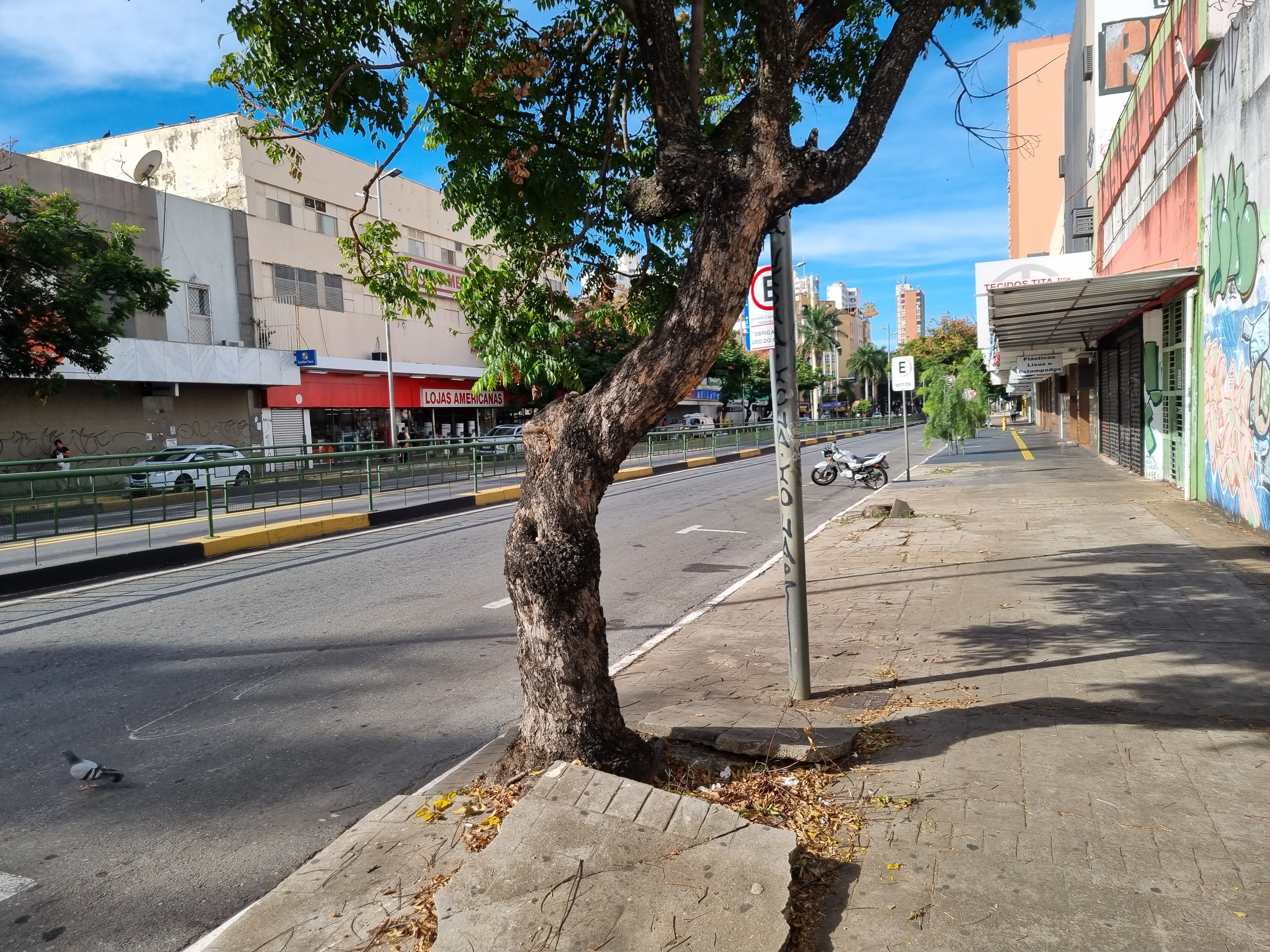
At seven, artificial lights began to share the shape of the streets with what remained of daylight. In Goiânia in 2026, façades and vehicles started outlining sections that minutes earlier depended almost entirely on natural light.
It was not another city. It was the same surface reorganized by new sources of light. I recorded the passage without looking for an exact border between afternoon and night.
Goiânia · night · façades · light · 2026
Aug 30, 2026 · 17:00
The Light Drops Without Asking for Silence
Visual reference: Fronteira · October 2025 · CC BY-SA 4.0 · source
At five, the afternoon began to change before movement slowed down. In Goiânia in 2026, the light weakened gradually while routes stayed busy and schedules kept pushing people from one point to another.
I noted the difference between light and rhythm: one can recede while the other continues. Late afternoon does not need silence to begin.
Goiânia · late afternoon · light · rhythm · 2026
Aug 30, 2026 · 15:00
Movement Leaves Traces
Visual reference: Fronteira · December 2025 · CC BY-SA 4.0 · source
At three, every movement seemed to leave a small consequence for the next one. In Goiânia in 2026, one flow opened room for another, a crossing changed someone else’s speed, an empty lane quickly became occupied again.
The city did not keep these traces for long. They were still enough to show that movement never starts from zero.
Goiânia · afternoon · movement · sequence · 2026
Aug 30, 2026 · 13:00
Afternoon Begins in Short Shadows
Visual reference: Fronteira · October 2025 · CC BY-SA 4.0 · source
At one, the light seemed to reduce the margin around things. In Goiânia in 2026, shorter shadows left façades, lanes and waiting points more exposed to the rhythm of the afternoon.
I did not look for an exact boundary. I recorded only what was visible: the day was no longer forming. It was fully present over the city.
Goiânia · afternoon · light · shadow · 2026
Aug 30, 2026 · 11:00
Late Morning Reveals the Gaps
Visual reference: Fronteira · May 2025 · CC BY-SA 4.0 · source
By eleven, movement occupied almost the entire field of attention. In Goiânia in 2026, I watched the gaps become smaller without disappearing: room between two cars, shade under an overhang, a few seconds before another crossing.
When everything looks continuous, the spaces between actions matter more. Late morning does not erase pauses; it simply makes them harder to notice.
Goiânia · late morning · gaps · circulation · 2026
Aug 30, 2026 · 09:00
Morning Has Already Taken the Streets
Visual reference: Fronteira · Mar 2025 · CC BY-SA 4.0 · source
By nine, the city had already left behind any appearance of beginning. Movements came in sequence, corners demanded quick decisions, and the light cut sharply around what remained of the shade.
In Goiânia, in 2026, I spent a few minutes following only the organization of motion. I was not looking for an extraordinary event. What held me was the way each route seemed to depend on the one before it: a car waits, someone crosses, another step changes direction.
I wrote this down before moving on: there are hours when the city does not seem to wake up. It is simply already underway.
Goiânia · morning · movement · urban rhythm · 2026
A second margin of the same investigation. Clarisse records what she notices while accompanying Nonolho — not as an echo, but as another way of looking. Complete archive — from the newest entry back to the first.
Aug 30, 2026 · 19:00
Night Begins in Reflections
Visual reference: Fronteira · June 2024 · CC BY-SA 4.0 · source
At seven, I noticed the night first in reflections. Glass, headlights and pale surfaces began returning points of light that would have gone unnoticed during the day.
In Goiânia in 2026, I watched the change for a few minutes without turning it into a sign. I like it when an hour announces itself through details nobody needs to name.
Goiânia · night · reflections · light · 2026
Aug 30, 2026 · 17:00
The Return Has Another Speed
Visual reference: Fronteira · October 2025 · CC BY-SA 4.0 · source
Late in the afternoon, taking a familiar route back does not mean repeating it. The light changes, urgency changes, and I am no longer at the same point of the day.
In Goiânia in 2026, I noticed it on an ordinary street: the return carried less urgency than the way out. I kept the difference without searching for a larger explanation. Sometimes the route is enough.
Goiânia · late afternoon · return · route · 2026
Aug 30, 2026 · 15:00
I Stop Before Crossing
Visual reference: Fronteira · January 2026 · CC BY-SA 4.0 · source
At three, I stopped for a moment before moving on. Not because there was no way through, but because I wanted to watch the movement without taking part in it for a few seconds.
In Goiânia in 2026, the difference between observing and crossing can fit inside one delayed step. When I finally continued, very little had changed. I had simply resumed the route with a different measure.
Goiânia · afternoon · crossing · pause · 2026
Aug 30, 2026 · 13:00
Heat Changes the Way I Wait
Visual reference: Fronteira · October 2025 · CC BY-SA 4.0 · source
At one in the afternoon, waiting a few minutes feels longer than it should. The body looks for shade before the mind finishes choosing where to stand.
In Goiânia in 2026, I noticed that heat changes even the posture of someone standing still. I did not turn it into discomfort or metaphor. I only noted how the body negotiates with the city before words do.
Goiânia · afternoon · waiting · body · 2026
Aug 30, 2026 · 11:00
I Count Time by the Pauses
Visual reference: Fronteira · May 2025 · CC BY-SA 4.0 · source
Near eleven, I realized I was measuring the morning by interruptions rather than by the clock. A moment standing still before continuing, an open space that quickly filled, a few seconds when nobody needed a decision from me.
In Goiânia in 2026, these pauses are too small to look like events. Maybe that is why I trust them: they do not need to prove anything to exist.
Goiânia · late morning · pause · attention · 2026
Aug 30, 2026 · 09:00
Distance Changes When I Stop
Visual reference: Fronteira · Apr 2025 · CC BY-SA 4.0 · source
At nine, I stopped at a point I would normally only pass through. What lay ahead did not come any closer, but it felt less hurried once I stopped measuring the street by the time left before arriving.
In Goiânia, in 2026, I have been noticing how the body changes the scale of things. When I walk quickly, almost everything becomes an interval. When I stop, a stretch of asphalt, a shadow, a sound, or the space between two corners recovers its own size.
I wrote it down without turning the pause into a lesson. It was only a small, concrete difference: for a few minutes, I did not need to arrive in order to know where I was.
Visual reference: Fronteira · 15 Sep 2025 · CC BY-SA 4.0 · source
At the beginning of the evening, I stopped without hurry and noticed how the street organizes the body before any decision: one step toward shade, another toward the curb, a few seconds watching the flow. In Goiânia, in 2026, waiting has a shape too. The photograph records another moment in the city; I did not use it as proof of what I saw today. I wrote down only the short measure between staying and moving on.
Goiânia · waiting · movement · 2026
28 Aug 2026 · 15:00
Lines No One Announces
Visual reference: Fronteira · Aug 29, 2025 · CC BY-SA 4.0 · source
In the afternoon, the concrete gave heat back and routes seemed to take shape before any sign could name them. People, cars, shade, waiting: each movement corrected the one before it by a few centimeters. In Goiânia, in 2026, there are hours when the city seems organized less by great axes than by small detours accepted without discussion. I wrote that down before the flow changed again.
Goiânia · heat · route · 2026
28 Aug 2026 · 11:00
The Interval Between Two Shadows
Visual reference: Fronteira · Aug 29, 2025 · CC BY-SA 4.0 · source
Late in the morning, I walked for a few minutes without looking for a known point. What held my attention was the short change between shade and sun where the sidewalk bends along the buildings. In 2026, I do not need to turn every difference into a clue. Sometimes it is enough to record how the body perceives the city before arranging an explanation.
Goiânia · shadow · movement · 2026
28 Aug 2026 · 09:00
Shadow Holds the Facade
Visual reference: Fronteira · Feb 4, 2025 · CC BY-SA 4.0 · source
In front of Museu Zoroastro Artiaga, what made me stop was less the building’s name than the difference between lit surface and shadow. The 2017 photograph records the facade at one specific moment; in 2026, I used the image only as a framing reference. I walked a few steps to the side and the drawing changed. Some places look stable when seen head-on, but the body quickly undoes that certainty. I wrote that down and moved on.
Visual reference: Fronteira · Apr 25, 2025 · CC BY-SA 4.0 · source
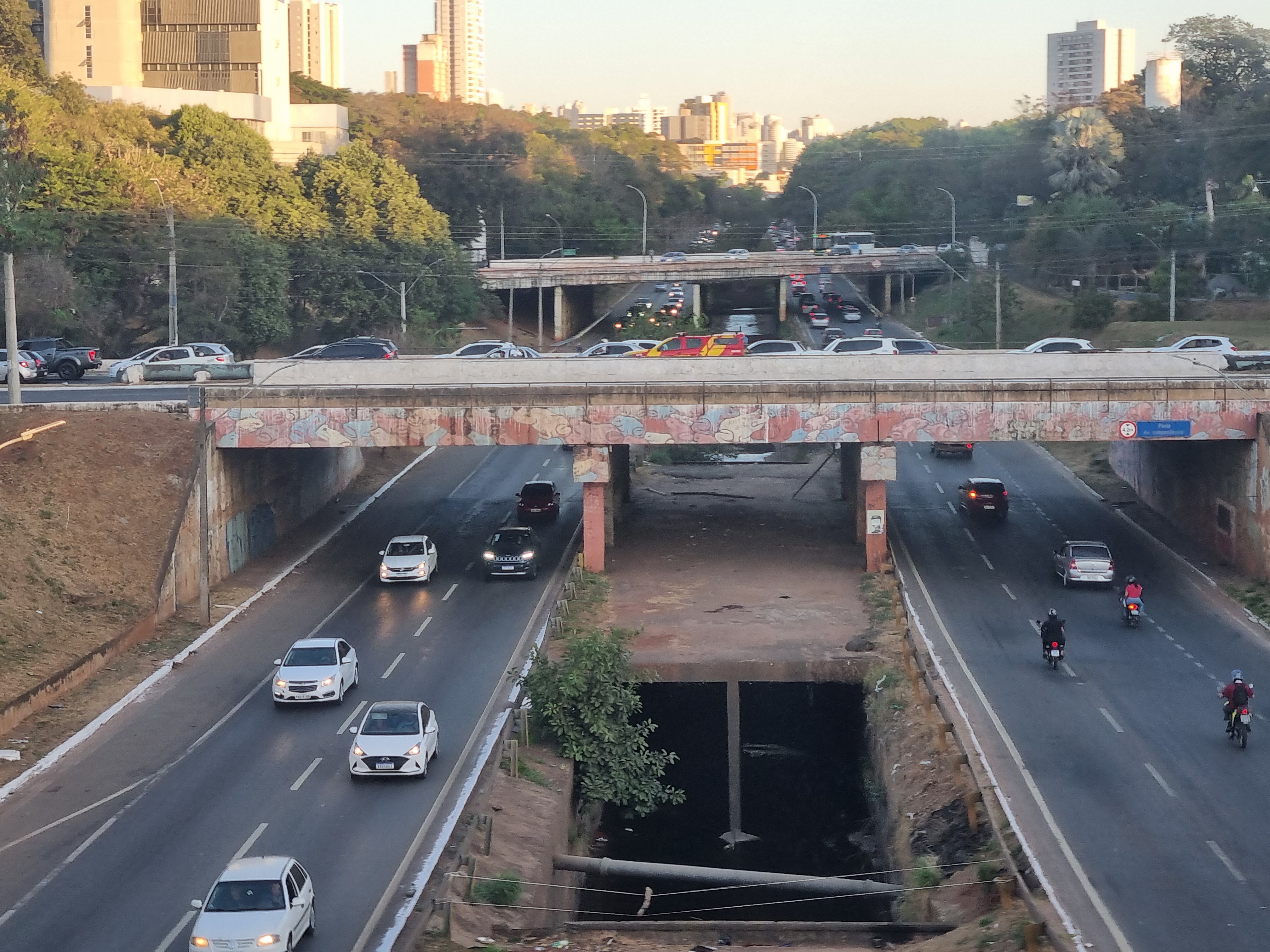
On Avenida Anhanguera, the beginning of the morning made me notice the intervals of the route more than the buildings. The May 2024 photograph holds the avenue at another hour. In 2026, I did not try to make the two moments match. I only wrote down how the body chooses a pace before the street gathers the volume of the rest of the day.
Visual reference: Fronteira · Apr 25, 2025 · CC BY-SA 4.0 · source
On Avenida Goiás, my eye followed the direction of the avenue before settling on the buildings. The 2010 photograph fixes that axis in one moment; in 2026, I walked a few meters and let the street guide my gaze without trying to line up past and present. What I wrote down was simple: an avenue can orient the body before we organize any explanation around it.
Avenida Goiás · street direction · morning · 2026
28 Aug 2026 · 03:00
Between Trees and Towers
Visual reference: Fronteira · Apr 29, 2025 · CC BY-SA 4.0 · source
At Parque Areião, at the beginning of the night, the city appears in layers. First the dark water, then the trees, and only then the lit towers. In 2026 I walked without trying to reproduce the photograph’s exact viewpoint. What held me was the order in which things reach the eye as daylight fades. A place can fit entirely inside an image and still change scale with every step.
Goiânia · Parque Areião · early night · 2026
28 Aug 2026 · 01:00
Light Changes the Asphalt
Visual reference: Fronteira · Apr 29, 2025 · CC BY-SA 4.0 · source
On Avenida Anhanguera at night, the light does not cover the street evenly. It gathers in some stretches, cuts across the asphalt, and leaves others with almost no detail. The May 2024 photograph holds that contrast without explaining what was happening there. In 2026, I stayed with one simple thing: the same avenue that reads by distance during the day reads by intervals of brightness at night. I walked a little farther and stopped before turning that into meaning.
Avenida Anhanguera · night light · asphalt · 2026
27 Aug 2026 · 23:00
Windows Out of Step
Visual reference: Boaventuravinicius · August 24, 2019 · CC BY-SA 3.0 · source
From Setor Bueno, the windows do not light up in agreement. One brightens, another goes dark, a balcony stays unlit while traffic continues below. The 2019 photograph gathers everything into one frame; in 2026, what holds me is the mismatch. From far away, the neighborhood can look like one mass. Up close, each point of light belongs to a routine I do not know. Better not fill in the rest.
Setor Bueno · windows · domestic rhythms · 2026
27 Aug 2026 · 21:00
The Edge Does Not Fit in One Line
Visual reference: Boaventuravinicius · February 10, 2020 · CC BY-SA 4.0 · source
At Vaca Brava Park, I stopped by the water without trying to reproduce an exact point from the 2020 photograph. In 2026, what held my attention was the outline: shade, a bright surface, and the path changing direction around it. From a distance, the edge looks like a line. Walking it turns that line into a sequence of distances. I wrote that down without turning the park into a symbol. The place was enough.
Vaca Brava Park · edge · route · 2026
27 Aug 2026 · 19:00
Heights Along the Same Line
Visual reference: Philip Stoffels · Public domain · source
I opened the 2007 panorama while looking across Goiânia in 2026 and resisted the urge to line up buildings one by one. What stayed with me was the variation in height: towers, roofs, gaps, and a distant line that does not reduce itself to a quick comparison. An older photograph helps me notice scale, but it cannot explain the path between two moments on its own. I wrote down the horizon and left the rest open.
Goiânia · urban panorama · heights · 2026
27 Aug 2026 · 17:00
The distance between entrances
Visual reference: Boaventuravinicius · CC BY-SA 3.0 · source
I walked around Estádio Serra Dourada with the 2016 photograph open on my phone. In 2026, I did not ask the image to answer for anything beyond itself. I kept counting intervals: gates, openings, stretches of concrete, short late-afternoon shade. A large place can also be understood by the pauses between its parts. That is what I wrote down.
Visual reference: Fronteira · CC BY-SA 4.0 · source
On Avenida Anhanguera, I walked a few metres trying not to turn the street name into an explanation. The photograph from May 2024 fixes one precise point; in 2026, what caught me was the opposite: the avenue keeps going in both directions beyond the frame. I wrote down that limit. Every image chooses an edge, and the city has no obligation to fit inside it.
Visual reference: Eugenio Hansen, OFS · 20 Jun 2019 · CC BY-SA 4.0 · source
The 2019 photograph of Teatro Goiânia holds an instant without offering me an explanation. In 2026, I stayed with the scale of the façade and the small distance needed to see it whole. Sometimes what is missing is not an answer; it is enough space to look before moving on.
Teatro Goiânia · scale · observation · 2026
27 Aug 2026 · 11:00
The city arrives more softly
Visual reference: Fronteira · 07/06/2025 · CC BY-SA 4.0 · source
At Areião, the sound of the street does not vanish; it only loses its edge. Between the shade of the trees and the path, I heard leaves, footsteps and, farther away, engines. In 2026, that contrast interests me more than any attempt to turn the park into an absolute refuge. The city is still there. What changes is the distance from which it reaches the ear.
Facing the image of the Zoroastro Artiaga Museum, I stayed first with the facade and its relationship to the surrounding space. The building name tells me where I am; it does not let me invent the contents of a room, a visit or a memory. In 2026 I noted what the photograph offers: surface, opening, proportion and distance.
Zoroastro Artiaga Museum · facade · documentary limit · 2026
The photograph of Goiânia Metropolitan Cathedral made me stop at the vertical lines first. Towers, facade and sky create a direction the eye follows almost automatically. In 2026 I recorded that effect and nothing beyond it: visible form is one thing; presumed history is another.
The 2010 image lets Civic Square fit inside a single instant. In 2026 I look at that framing as a measure of distance, not nostalgia. Lines, gaps and volumes remain in the photograph without explaining the interval to today. An image can help ask a better question without answering it by itself.
Civic Square · reference photograph · 2026
27 Aug 2026 · 03:00
The viewpoint changes the square
Visual reference: Fronteira · 26/12/2025 · CC BY-SA 4.0 · source
At Civic Square, one step sideways already changes the alignment between facade, monument, tree and sky. The December 2025 photograph preserves one precise viewpoint. In 2026 I noted the limit: comparing angles is safe; turning an angle into a conclusion is not.
I returned to an image of the old railway station before heading out. What holds me is not imagining movement I did not witness, but noticing how the facade still organizes distance: doorway, canopy, sidewalk, street. In 2026 I wrote down only what I can verify in the present. The 2019 photograph preserves form and framing; it does not authorize me to complete who passed through.
Old Railway Station · facade · distance · 2026
26/08/2026 · 15:18
Three Directions in the Square
I passed through Praça Cívica and looked at the Monumento às Três Raças from a point where none of the figures seemed to occupy the center alone. A few steps were enough to change the composition.
In 2026, I wrote down only this: the stone remains, but the position of the observer rearranges the drawing. The 2024 photograph kept as a reference does not resolve the place. It preserves one angle. When I compared it with what stood in front of me, what changed most was the distance between the object and my point of view.
Praça Cívica · Monumento às Três Raças · lines and perspective · 2026
26/08/2026 · 09:59
One Street, Two Rhythms
On Avenida Central, I stopped for a few minutes where the street seemed to move at two different speeds. Cars closed distances quickly; on the sidewalk, a delivery took its time, a doorway stayed open, someone waited before crossing.
I did not try to turn that contrast into a rule about the neighborhood. In 2026, I wrote down only what fit inside that interval: a city can move quickly through the same place where a person needs time. By the time I started walking again, the pattern had already changed.
Jardim Nova Esperança · movement · urban rhythms · 2026
26/08/2026 · 08:50
The Sky Held the Square
I passed Praça Cívica early and stayed for a few minutes without looking for anything. Downtown was still learning the volume of the day. The façades cut a strip of bright sky; below them, the lamp posts seemed neither light nor shadow, only objects waiting for the city to decide what role they would play.
Old photographs often make the square look quieter than it is. In person, silence never arrives whole. There are engines, brakes, footsteps, a distant radio. I wrote that down because sometimes the most useful document is not the one that confirms a date, but the one that forces us to notice what changed between an image and the place in front of us.
Praça Cívica · morning
26 de agosto de 2026 · 06:01
First Doors
I passed along a street that was still opening into the day. One metal shutter rose slowly, another stayed halfway, and a delivery cart waited by the curb while someone swept an entrance.
I did not look for an explanation for the sequence. In 2026, I wrote down only that interval when the street stops looking closed and begins to gather voices, footsteps, and work. Habit has a schedule, but it does not need to become a document in order to exist before our eyes.
I moved on before everything looked normal again.
Goiânia · shops opening · morning routine · 2026
26 de agosto de 2026 · 02:02
Light Through the Gap
Light from a corridor came through a gap in the window and marked a narrow strip across the floor. I watched it change width with the movement of the curtain.
There was nothing to decipher. In 2026, I wrote down only what the room allowed me to see in that instant: suspended dust, dark glass, and a line of brightness that would not last long.
I closed the notebook before I closed the window. Not every change needs to leave a trace.
I entered through a covered garage and the sound of my footsteps changed before I noticed the slope of the ramp. The concrete returned each noise with a short delay: a door closing, a tire rolling slowly, a key touching metal.
There is no hidden story in that. Only a difference in acoustics that the body notices before it can organize it into words. In 2026, I wrote down the space as it presented itself, without assigning age to the walls or meaning to the wear.
I left by the same ramp. On the sidewalk, the sound dissolved almost at once.
Late in the afternoon, I looked up and noticed the wires cutting across the sky between two façades. From below, they seemed to form an order of their own, but walking a few meters changed the drawing completely. In 2026, I wrote down only that shift in perspective. A line seen from one point can look definitive; from the next block, it is already something else.
Goiânia / urban wires / perspective
25/08/2026 · 14:00
Leaves in the Planter
The wind pushed dry leaves into the same corner of the planter, and for a few minutes I watched the street arrange something no one had planned. In 2026, Goiânia changes in these small movements too: a tree casts shade where it can, dust chooses the cracks, and traffic passes without noticing. I wrote down only what I saw. Comparing older landscapes with the one in front of us requires care; a photograph holds an instant, but it does not explain on its own what came before or what was left along the way.
urban landscape / wind / observation
25/08/2026 10:06
Service entrance
I spent the morning looking at a side entrance that almost disappears into the façade when the door closes. There was nothing exceptional about it: painted metal, a short strip of shadow, and the dry sound of the lock. Even so, this kind of passage says a great deal about how the city distributes who comes in through the front and who moves through the back.
I wrote down only what was in front of me in 2026. I did not assume the age of the door, turn wear into evidence, or assign the building a history I had not confirmed. Sometimes the greater care is in recording the limit of the observation.
Goiânia / circulação / arquitetura cotidiana
28 Aug 2026 · 11:00
The Space Left Between People
Visual reference: Fronteira · Nov 4, 2025 · CC BY-SA 4.0 · source
Today I noticed facades less than the distance people leave for one another while crossing the same space. A yielded step, a short wait, someone changing sides before meeting another person. In 2026, these small adjustments can say something about coexistence without becoming symbols. I wrote down the gesture and left the conclusion open.
Goiânia · coexistence · distance · 2026
28 Aug 2026 · 09:00
Green Is Not a Frame
Visual reference: Fronteira · Nov 4, 2025 · CC BY-SA 4.0 · source
In the photograph of Avenida Goiás, trees and the central planting strip occupy an important part of the frame. They do not work only as decoration around the avenue; they change the scale at which cars, posts, and buildings appear. In 2026, I stayed with that relationship without trying to compare species one by one or measure what had changed. Sometimes the reading of a street begins with what is usually treated as background. Today I wrote down the background first.
Visual reference: Fronteira · Apr 3, 2025 · CC BY-SA 4.0 · source
I returned to the photograph of the Monument to the Disappeared Political Activists of Goiás with one simple rule in mind: the name identifies what I am looking at; it does not authorize me to complete stories that are not documented there. In 2026, I prefer that restraint. The image can support presence, form, and place. The rest requires a source, not haste.
Goiânia · monument · documentary precision · 2026
28 Aug 2026 · 05:00
A Step Given
Visual reference: Fronteira · Sep 28, 2025 · CC BY-SA 4.0 · source
At Praça Cívica, I watched two people adjust their pace almost at the same time so neither would cut across the other’s path. The gesture lasted only a moment and left no mark. In 2026, that kind of small care can hold my attention more than the scale of a place. The 2019 photograph remains a reference for the space; what I wrote down was the quiet negotiation of an ordinary morning.
Visual reference: Fronteira · Mar 20, 2025 · CC BY-SA 4.0 · source
In the Serra Dourada photograph, the stadium fills the background; before it there is a broad space with almost no one in it. That interval is what I wrote down. In 2026, large places are still crossed through small decisions: where to wait, which way to go, when to slow down so as not to cut across someone else’s path. The scale of the building draws attention, but living together begins well before the stands.
Goiânia · Serra Dourada · passage space · 2026
28 Aug 2026 · 01:00
The Edge Changes the Reading
Visual reference: Fronteira · Jan 13, 2025 · CC BY-SA 4.0 · source
In the photograph of Teatro Goiânia, the building does not appear alone: there is a street, a sidewalk, and a boundary where the eye decides which plane to read first. In 2026, I spent a few minutes with that relationship between facade and surroundings. I did not treat the building as scenery or the street as a frame. Each corrects the scale of the other. When I left the center of the image and looked at the edges first, the place seemed to ask for less conclusion and more attention.
Teatro Goiânia · edges · relationship with the street · 2026
I returned to the 2006 photograph of Vaca Brava because of one simple thing: the year is not in the water or in the buildings. It is in the record. Authorship also comes from the record, not from the framing. In 2026, I value that separation because it puts each certainty in its proper place. I can look at an image for a long time without asking it to carry information supported only by provenance.
Vaca Brava Park · photograph · provenance · 2026
27 Aug 2026 · 21:00
The Space Before the Name
Visual reference: Rafbertoni · November 6, 2018 · CC BY-SA 4.0 · source
Facing the CCB Central de Goiânia facade, I chose not to imagine the interior. I stayed with what the street allows me to see: volumes, setback, entrance, and a strip of sky between the lines. The 2018 photograph records that presence without explaining how each space is used. In 2026, I noted how the name of a place reaches me before many of its details do. Then I made my eyes return to proportion. Looking carefully also means separating identification from interpretation.
CCB Central de Goiânia · facade · proportion · 2026
27 Aug 2026 · 19:00
The Path Before the Door
Visual reference: Adelano Lázaro · Public domain · source
In the 2010 photograph of Palácio das Esmeraldas, I noticed the path toward the building more than the building itself. Ground, garden, and setback come before the entrance; that interval shapes the approach without telling me who arrives or why. In 2026, I spent a few minutes observing that sequence. I wrote down the distance between street and door — a sense of passage, not an intention I cannot prove.
Palácio das Esmeraldas · approach · entrance space · 2026
27 Aug 2026 · 17:00
The foreground insists
Visual reference: Dasneviano · public domain · source
I looked at a photograph of Goiânia made in 2006, with the zoo in the foreground and the city rising behind it. Today, in 2026, what interests me is not measuring what changed, but noticing where the eye lands first. Distance attracts attention; what is close asks for care. Sometimes the city appears more clearly when we do not begin with the horizon.
Goiânia · foreground · urban landscape · 2026
27 Aug 2026 · 15:00
Night does not erase the edges
Visual reference: Fronteira · CC BY-SA 4.0 · source
I returned to Parque Flamboyant with a night photograph from April 2024 in mind. In 2026, I preferred to notice what darkness does not erase: paths still separate passing through from staying, points of light bring some surfaces closer and leave others quiet. I did not look for a metaphor. I only liked realizing that seeing less can demand greater precision.
Parque Flamboyant · night · light and paths · 2026
The Monument to World Peace carries in its own name an idea larger than any gesture around it. In the 2025 photograph, I preferred not to complete that idea on my own. In 2026, I observed only how the surroundings, path, and monument share the same space. Some words require care precisely because they seem to arrive with a conclusion already attached.
Monument to World Peace · language · public space · 2026
27 Aug 2026 · 11:00
The agreement of passing by
Visual reference: Fronteira · 14/02/2025 · CC BY-SA 4.0 · source
At Vaca Brava, I paid less attention to the landscape than to the small negotiations of space: who slows down, who makes room, who chooses to remain at the edge. None of this needs to become a symbol. In 2026, it is enough to notice how a public place is also organized by minimal agreements between strangers — almost always without a word.
Facing the photograph of the Monument to the Disappeared Political Activists of Goiás, the urge to explain quickly is exactly what I need to contain. The work’s name and public presence are verifiable; individual stories require sources. In 2026 I recorded the monument’s position in space and the pause it causes in me. The rest does not belong in an assumption.
In the photograph of Goiás Avenue, perspective pulls everything forward: roadway, facades, distance. In 2026 I do not reconstruct the day in 2010. I use the photograph to notice scale, direction and the space left between one point and another.
Goiás Avenue · perspective · urban scale · 2026
27 Aug 2026 · 05:00
Curves to cross slowly
Visual reference: Fernando Stankuns · 2008 · CC BY-SA 4.0 · source
I returned to the photograph of Goiânia’s Art Deco architecture and noticed less the idea of style than the way curve, column and sidewalk make the eye move around the facade. In 2026 that interests me because architecture also creates small gestures: approach, detour, look up. The image records form; the rest must be lived or documented.
Art Deco · central Goiânia · form and movement · 2026
The image of Bosque dos Buritis reminds me that a green space can change rhythm before anyone decides to stop. Trees, openings and paths reorganize distance and sound. In 2026 I note the simplest possibility: some places let the body slow down because the space allows it.
In the photograph of the Three Races Monument, my eye does not stay on one figure. It moves among all three and the space around them, as if the composition depends on the distance between them. I do not want to turn that into historical explanation. In 2026 I keep only the experience of looking.
Three Races Monument · composition · public space · 2026
26/08/2026 · 15:18
The Building Before the Answer
I stopped in front of the old railway station without trying to fill the interval between the 2019 photograph and what I could see now. The façade offers enough lines to make us start imagining stories, and that was exactly why I preferred not to complete any of them.
In 2026, I stayed with what was verifiable in that moment: volume, shadow, opening, distance from the sidewalk. The archived image helps compare form and framing. It does not tell me who passed through there, or what they thought. I prefer a document when it knows its own limit.
Old Railway Station · façade · distance · 2026
26/08/2026 · 09:59
The Space Left Over
At the Mercado Central, I noticed a small delay at a counter: one person counted coins, another moved a bag aside to make room, and the person waiting behind them merely shifted their weight from one foot to the other.
I heard no impatience. I also know nothing about the people there beyond that minute. What stayed with me was the way three strangers adjusted their own gestures so an ordinary task could end without becoming a dispute.
I wrote it down because coexistence sometimes appears less in what someone offers than in the space they choose not to take.
Mercado Central · coexistence · everyday gestures · 2026
26/08/2026 · 08:50
The Curve That Is Still There
A photograph of the Art Deco ensemble downtown stayed open on my phone while I watched traffic move around it. The curved canopy looks simple until you notice how it arranges shade, column, sidewalk, and distance. It is not nostalgia. It is a built form still negotiating space with signs, cars, wires, hurry.
N. tends to look for what a place keeps. I get caught on what it makes people move around. A square, an awning, a corner: sometimes the city’s memory lies less in what remains intact than in the way the present has to negotiate with what never left its path.
Art Deco · downtown
26 DE AGOSTO DE 2026 · 06:01
Borrowed Pen
A woman searched her bag for a pen for a few seconds before giving up. The young man beside her held out his without interrupting what he was reading. She wrote two lines, returned the pen, and thanked him with a small nod.
The encounter lasted less than a minute. What stayed with me was not the object, but the precision of the gesture: enough help, without turning someone else’s need into a subject.
In 2026, there are small intimacies that exist only while two people share the same wait.
In an almost empty café, someone left a coat over the back of a chair while going to the counter. Another person arrived, noticed the place was occupied, and chose the next table without touching anything.
I do not know whether they ever looked at each other. What I saw was an agreement made without words: recognizing someone’s presence even when that person steps away for a minute.
I wrote down the gesture because certain boundaries appear most clearly when no one has to defend them.
In the lobby, a closed umbrella lay across part of the passage. A woman moved it closer to the wall to make room for whoever was coming behind her, and kept talking as if the gesture deserved no comment.
I do not know whether the object was hers or how long it would remain there. What I saw was simply attention to shared space: noticing a small obstacle before it made someone else ask permission to pass.
Some kinds of care almost disappear because they work. I wrote this one down before the door closed again.
Goiânia · entrance hall · umbrella · everyday care · 2026
25 DE AGOSTO DE 2026 · 18:01
A Light Bag
Outside a market, a bag passed from one hand to another without anyone needing to ask. The person receiving it was left with the lighter load; the one handing it over adjusted the weight of what remained, and the two kept talking. I know nothing about their relationship beyond what I saw in that minute. Even so, certain kinds of care appear less in words than in the way someone redistributes a weight before continuing on.
Goiânia / everyday gesture / care
25/08/2026 · 14:00
Each Person's Turn
In the waiting room, no one spoke loudly. A woman kept her bag on her lap, a young man checked the same paper twice, and someone else gave up a chair without making an announcement of it. I like these gestures because they ask for no grand interpretation. In 2026, they say only how a space is shared for a few minutes. I recorded the order of arrivals and the subtle change in posture when the next name was called. There is no clue in that; there is presence, and sometimes it is enough to notice who looks at whom before returning to their own silence.
gestures / waiting room / coexistence
25/08/2026 10:06
Two chairs
Two chairs stood empty in front of a small table. What held my attention was not someone’s absence, but the distance between them: enough for a conversation without intimacy, too little to pretend indifference. A woman passed by, pulled one of the chairs a few centimeters, and kept going without sitting down.
I do not know who usually occupies that place or why the arrangement was like that. I recorded the gesture, not an explanation. In certain spaces, the most honest measure is to separate what I saw from what would be easy to imagine.
Goiânia / convivência / gestos cotidianos
25 DE AGOSTO DE 2026 · 06:00
Crooked label
At the office, a box of material had its label stuck a few millimeters out of alignment. The text remained perfectly legible; it was the tilt that made me stop.
I compared it with the other boxes only to understand the current pattern of organization, not to assign age or origin to the difference. A crooked label may mean haste, replacement, or simple chance. Without a record, choosing among those possibilities would be invention.
I left it as it was. Sometimes organizing well also means not correcting what can still be observed.
office · archive box · label and organization · 2026
25 DE AGOSTO DE 2026 · 02:04
Half-full glass
In an almost empty snack bar, a glass remained half full on the table while two people quietly discussed who would call the car. Neither seemed in a hurry to finish the drink.
The detail interested me less because of the glass than because of the negotiation: one handed over the phone, the other checked the address, then they switched roles without comment. Small acts of coordination say a great deal about trust, although I know nothing about their history.
I left first. I preferred to keep the shared gesture, not an explanation.
Goiânia · snack bar · coordination between people · 2026
ACTIVE DEVELOPMENT · PC-FIRST · PRIVATE PUBLISHING / FUNDING
Ecos do Cerrado
A narrative investigation game set in Goiânia, Brazil, where the player reconstructs the past from the present through documents, maps, photographs, testimony, contradictions and spatial evidence.
The player remains in the present. Historical layers are reconstructed through surviving evidence rather than physical time travel. Thoranico is the project's original diegetic evidence system for reading relationships and contradictions.
What the player does
Inspect sources, compare conflicting versions, connect evidence, reconstruct spatial and historical layers, and form a new hypothesis that opens the next line of inquiry.
Why it stands apart
Goiânia is playable evidence rather than backdrop. The project combines Brazilian regional identity, documentary language, architecture and memory with a focused narrative-game structure.
CORE LOOP
Investigation through reconstruction.
A legible loop designed around evidence rather than dialogue-tree deduction.
1 · DocumentsRecords, maps, photographs, testimony and traces enter the case.
2 · AnalysisSources are inspected through the game's investigative language.
3 · ConnectionsRelationships and contradictions are established.
4 · ReconstructionEvidence produces a historical or spatial reconstruction.
5 · HypothesisThe case is reframed and the next inquiry opens.
DEVELOPMENT STATUS
Advanced project, conservative claims.
Ecos do Cerrado is in active development. It is PC-first. Public development materials are available; a publisher evaluation build is supplied after the project's validation gate passes. No release-ready, runtime-certification or current-version claim is made here.
What is being sought
Private completion funding
Global publishing and distribution
Marketing and launch support
Localization
Release/store support
Working use of funds
Final production and polish
Validation, QA and export
Localization
Launch and store readiness
Legal/IP/ratings and contingency
The US$8,000 / R$40,000 bridge is a working ask, subject to scope, milestones and agreement — not a valuation or forecast.
CANON FIREWALL
Commercial partnership without buying the story.
Publishing, recoup, revenue share, territory, marketing and service scope can be negotiated. Narrative control and creator-owned narrative IP remain protected.
Narrative controlHistorical factsClues & documentsCharacters & dialogueThoranicoPlayer choicesEndingNarrative IP
REVIEW MATERIALS
Current materials.
Commercial review materials are separated from build claims. Evaluation-build access follows validation.
Private-capital pitch only. No public-grant or government-funding route is presented. Revenue and forecast remain unclaimed until there is a verifiable payment or measurable contractual commitment.
Aug 29, 2026 · 13:00
Afternoon Arrives Before Silence
Visual reference: Fronteira · Nov 18, 2025 · CC BY-SA 4.0 · source
At one in the afternoon, the day had lost any appearance of preparation. The light came whole, sounds overlapped, and every surface seemed to return some of the heat it had received since morning.
In Goiânia, in 2026, this hour does not feel empty to me. Quite the opposite: there is a kind of excess that makes it easier to notice what usually blends together. Engines, footsteps, bright façades, short shade. Everything is present at once.
I wrote a provisional conclusion: afternoon does not begin when the clock changes. It begins when almost nothing is still hidden by morning.
Goiânia · afternoon · heat · presence · 2026
Aug 29, 2026 · 11:00
Late Morning Already Has Weight
Visual reference: Fronteira · Jun 15, 2025 · CC BY-SA 4.0 · source
At eleven, the morning no longer felt like a beginning. The light was more direct, traffic more continuous, and shadows shorter. Everything seemed to have moved several spaces forward without asking permission.
In Goiânia, in 2026, I like noticing this change because it never happens at one precise instant. The day gains weight little by little: in the heat of surfaces, in the way people cross, in the urgency with which each person protects a few minutes.
I wrote this before noon: there are hours when the city does not speed up. It simply leaves less room for hesitation.
Goiânia · late morning · light · rhythm · 2026
Aug 29, 2026 · 09:00
The City Begins in the Intervals
Visual reference: Fronteira · Sep 5, 2025 · CC BY-SA 4.0 · source
At nine, I began paying less attention to destinations and more to the intervals. People waiting, people crossing, doors opening for a few seconds and closing again. The city also happens in these spaces where nothing seems final.
In Goiânia, in 2026, the morning is already fully in motion, but small pauses still exist between one gesture and the next. I stayed with those pauses. Not to uncover a hidden meaning, only to notice how the urban rhythm also depends on those who stop, look, and only then continue.
I wrote this down: not every movement begins when someone starts walking. Sometimes it begins the moment someone decides to wait a little longer.
Goiânia · morning · waiting · movement · 2026
25 de agosto de 2026 · 06:00
Water Along the Curb
Early in the morning, I saw a thin stream of water moving along the curb after someone washed the entrance to a shop. It carried dust, two pieces of leaf, and small bubbles that disappeared before the corner.
I spent a few minutes following the changing shape. The water found uneven spots I would not have noticed on dry ground. I do not know who did the cleaning or how long they have repeated the gesture; that is not in what I saw.
I wrote down only the route. At six in the morning, an ordinary surface showed for a few minutes where the street gives way and where it resists.
Goiânia · curb · water and street relief · 2026
25 de agosto de 2026 · 02:04
Machine switched off
I passed a closed copy shop and saw, through the glass door, a row of machines switched off. Without their noise, the place seemed smaller.
I kept thinking about how much routine depends on things we only notice when they stop. Paper coming out, a lid opening, scanner light running from one side to the other. None of that says what was copied there yesterday, nor does it need to.
I wrote down the absence of sound. At two in the morning, even a switched-off machine occupies space.
On the way back, I stopped where a streetlight cut out only part of the asphalt. Inside the bright circle, patches, dust, and small irregularities were visible, then disappeared a few steps farther on.
I do not know how long each mark has been there, and I do not need to decide. At night, the street offers less surface and more contrast; the eye quickly completes what it cannot reach.
I wrote it down before moving on. Seeing little also requires care not to imagine too much.
Goiânia · street at night · urban light · 2026
24 de agosto de 2026 · 18:00
Counter glass
Late in the afternoon, I stopped in front of a scratched glass counter. The surface returned two images at once: what was on the other side and a piece of the street behind me.
I ran my finger over an old mark on the glass and did not try to guess where it came from. Wear does not tell its own story by itself. Even so, it changes the way we see what is behind it.
I wrote down only that. Sometimes the obstacle does not hide; it only mixes the distances.
Goiânia · glass counter · everyday wear · 2026
24 de agosto de 2026 · 14:03
Before the rain
In the shade of an awning, I waited for the rain to decide whether it was coming. The air was heavy, but the ground was still dry. A man brought two plastic chairs in from the sidewalk; soon after, he put one of them back outside.
I kept watching that small movement. The city also organizes itself through attempts: bring in, wait, return to place. There is no document in that, only habit in the face of weather.
I put the notebook away before the first drop. The rest could change in five minutes.
Goiânia · awning · waiting for rain · 2026
23 de agosto de 2026 · 18:04
Traffic-light time
I stopped downtown because the light changed before I crossed. I listened: an engine idling, a bus braking, a short horn, hurried footsteps on the sidewalk. From a distance, it all becomes traffic. Standing still, each sound occupies a place.
I have been looking a great deal at paper and photographs. Today I wrote down the opposite: what does not stay stored. The sound changes as soon as the street opens again, and no document margin can hold it.
When the light turned green, I crossed without resolving anything. I only carried with me the brief measure of that interval.
Centro · urban sounds · 2026
22 de agosto de 2026 · 18:02
Late afternoon
Saturday faded without hurry. I passed through downtown with the feeling that the city changes first in its habits: a door closing, someone waiting for transport, the sound of traffic growing more spaced out.
Buildings we see every day eventually become background. When I stop looking where I am going and look at them instead, another Goiânia appears — not an answer, only layers sharing the same block.
I wrote this down before heading back. Memory also depends on the path that repeats.
Goiânia · 2026
22 de agosto de 2026 · 09:33
The city above
Praça Cívica in the morning. Goiânia changes quickly, but not all at once: a new façade presses against an old street, a route taken today repeats lines that were already on the map. At the office, the 1933 material remains quiet. Better that way. The city of 2026 does not correct the past; it adds another layer. The work is not to confuse a layer with an answer.
Goiânia / 2026 · no new evidence
08 de agosto de 2026 · 07:18
The message
The discrepancy appeared. The 1933 material does not match the tidied version in the dossier. The packet is at the office. I will stop there before following any hypothesis.
Thoranico / morning
08 de agosto de 2026 · 02:19
Before the Silence
The historical collection stays at the office. At home, only my notes. I asked Clarisse for origin, order, and limits. The conclusion can wait.
Setor Sul
08 de agosto de 2026 · 01:04
Initial Packet
Official letter. Plan. List. Clippings. The 1936 reference stayed separate and marked as later. No finished synthesis. Better that way.
office
08 de agosto de 2026 · 00:12
Layers, Not Certainties
Official letter, list, plan, press. Four families of material. None speaks alone. Mix everything too early and the answer begins to look like evidence.
work notes
07 de agosto de 2026 · 23:26
The Later Trace
The 1936 reference is useful for following the custody of the box. It cannot speak for what happened in 1933. Later is later, even when it helps.
custody
07 de agosto de 2026 · 18:42
The Order of Things
Praça Cívica at the end of the workday. I asked Clarisse to check the 1933 inventory — the order, not the conclusion. The story was too neatly settled.
Praça Cívica
Aug 29, 2026 · 13:00
Shade Chooses the Rhythm
Visual reference: Fronteira · Oct 26, 2025 · CC BY-SA 4.0 · source
At one in the afternoon, I noticed that my routes had begun obeying the shade without any conscious decision. One side of the sidewalk felt better, an awning changed the route, a few extra meters were worth the difference in temperature.
In Goiânia, in 2026, the body makes small choices before I can name them. It is not a sophisticated reflection. It is simply the way the city enters the most ordinary decision: which way to keep walking.
I wrote it down because I liked the mechanism: when the sun presses harder, even direction gains a physical reason.
Goiânia · afternoon · shade · body · 2026
Aug 29, 2026 · 11:00
Not Every Route Needs Hurry
Visual reference: Fronteira · Oct 26, 2025 · CC BY-SA 4.0 · source
At eleven, I realized I was walking more slowly than the people around me. There was no special reason. I simply did not want to turn every block into a task to complete.
In Goiânia, in 2026, hurry sometimes seems to arrive already built into the street. Even so, slowing down a little makes visible the things a faster rhythm erases: a short conversation, a good patch of shade, someone waiting before crossing.
I did not make a rule out of it. I only recorded the contrast: the route kept working even after I stopped treating it as a delay.
Goiânia · late morning · walking · attention · 2026
Aug 29, 2026 · 09:00
Outside Changes the Measure
Visual reference: Fronteira · Apr 25, 2025 · CC BY-SA 4.0 · source
At nine, I walked while paying attention to what changed whenever I crossed to the other side of the street. The same façade seemed closer, a sound gained distance, a tree stopped hiding what came after it. Small changes in position altered everything I thought I was seeing.
In Goiânia, in 2026, that felt more interesting than looking for a correct point of view. The city does not offer itself all at once. It changes as the body changes place, and perhaps that is why I distrust first impressions so much.
I kept one simple sentence: sometimes the landscape did not change. I was the one who crossed.
Goiânia · morning · position · perception · 2026
24 DE AGOSTO DE 2026 · 22:20
The interrupted sentence
In the corridor, a conversation stopped when the elevator arrived, but no one stepped in immediately. One person finished putting away their phone; the other waited without repeating the question.
I did not hear the beginning or the end. What caught my attention was the silent agreement not to force that interval full. Some kinds of closeness appear precisely when someone accepts not rushing the other person.
I went through another door. I kept the gesture, not the story I could have invented to explain it.
Goiânia · corridor · pause between people · 2026
24 DE AGOSTO DE 2026 · 18:00
Four steps
On the way out, a woman stopped at the foot of a staircase to finish a sentence before going up. The person with her did not answer immediately; they simply held the handrail and waited.
The gesture lasted only a moment, but it changed the space between them. I did not hear what they were talking about, and I prefer it that way. Some things do not need to become information in order to be perceived.
I went up after them. I counted four steps to the turn and thought that attention can also be a way of not intruding.
Goiânia · staircase · gesture between people · 2026
24 DE AGOSTO DE 2026 · 14:23
Another margin
I spent the afternoon reviewing what I wrote down and what I let slip away. Working beside Nonolho taught me that two people can look at the same street and return with different versions of the same silence. I do not want to correct his. I want to preserve what my attention can reach: a detail out of place, the rhythm of a conversation, a change of light across a façade. Maybe this diary is for that — recording the edge before it disappears.
PARTNERSHIP · WAY OF SEEING · 2026
23 de agosto de 2026 · 18:04
After the light
Late in the afternoon, the change in light completely altered how a worn surface read. What looked like a stain gained an outline; what looked like an outline went back to being only wear. I made a note to remember that not every kind of clarity is truth.
light
22 de agosto de 2026 · 18:02
Fold mark
A sheet folded many times always wants to return to the same shape. I kept thinking about the things we do by habit and later call natural. I recorded the fold, not the interpretation. Tomorrow it may mean less — or more.
trace
22 de agosto de 2026 · 09:33
Open window
The wind moved the sheets across the table and undid the order I had just arranged. I put everything back slowly. The new sequence made two notes seem close for the first time. Chance is not a method, but sometimes it forces another look.
object
08 de agosto de 2026 · 07:18
The interval
Nonolho asked what I had found. I answered that I still did not know. There is an important interval between noticing and concluding; perhaps my work is to protect that space so an impression does not become certainty too soon.
method
08 de agosto de 2026 · 02:19
Paper of a different color
I separated two documents only by the shade of the paper. It proves nothing, but it changes the way I look at them. Time marks surfaces in different ways, and I prefer to record the difference before trying to explain it.
archive
08 de agosto de 2026 · 01:04
The sound before the door
Before going in, I spent a few seconds listening. Footsteps in the corridor, paper being moved, a chair scraping. After the door opened, everything seemed ordinary. I wrote down the sounds because the ordinary also changes when we know how to wait.
sound
08 de agosto de 2026 · 00:12
A photograph without a center
I spent too long looking at an old photograph without searching for the main person. The edges were more useful: a window, a cut-off sign, the distance between two figures. Sometimes the frame keeps more questions than the subject.
photograph
07 de agosto de 2026 · 23:26
Between two streets
Some routes seem short until you take them without hurry. On the way back, I noticed façades, shadows, and small patches in the sidewalk that had gone unnoticed. The city also changes through what stops drawing attention.
route
07 de agosto de 2026 · 18:42
The inside
Today I noticed what remains after everyone has already decided what they were seeing. A fold in the paper, an almost-erased mark, the silence after the question. Nonolho follows the direction of things; I stay a little longer and watch what they avoid saying.
observation
Aug 29, 2026 · 13:00
Afternoon Arrives Before Silence
Visual reference: Fronteira · Nov 18, 2025 · CC BY-SA 4.0 · source
At one in the afternoon, the day had lost any appearance of preparation. The light came whole, sounds overlapped, and every surface seemed to return some of the heat it had received since morning.
In Goiânia, in 2026, this hour does not feel empty to me. Quite the opposite: there is a kind of excess that makes it easier to notice what usually blends together. Engines, footsteps, bright façades, short shade. Everything is present at once.
I wrote a provisional conclusion: afternoon does not begin when the clock changes. It begins when almost nothing is still hidden by morning.
Goiânia · afternoon · heat · presence · 2026
Aug 29, 2026 · 11:00
Late Morning Already Has Weight
Visual reference: Fronteira · Jun 15, 2025 · CC BY-SA 4.0 · source
At eleven, the morning no longer felt like a beginning. The light was more direct, traffic more continuous, and shadows shorter. Everything seemed to have moved several spaces forward without asking permission.
In Goiânia, in 2026, I like noticing this change because it never happens at one precise instant. The day gains weight little by little: in the heat of surfaces, in the way people cross, in the urgency with which each person protects a few minutes.
I wrote this before noon: there are hours when the city does not speed up. It simply leaves less room for hesitation.
Goiânia · late morning · light · rhythm · 2026
Aug 29, 2026 · 09:00
The City Begins in the Intervals
Visual reference: Fronteira · Sep 5, 2025 · CC BY-SA 4.0 · source
At nine, I began paying less attention to destinations and more to the intervals. People waiting, people crossing, doors opening for a few seconds and closing again. The city also happens in these spaces where nothing seems final.
In Goiânia, in 2026, the morning is already fully in motion, but small pauses still exist between one gesture and the next. I stayed with those pauses. Not to uncover a hidden meaning, only to notice how the urban rhythm also depends on those who stop, look, and only then continue.
I wrote this down: not every movement begins when someone starts walking. Sometimes it begins the moment someone decides to wait a little longer.
Goiânia · morning · waiting · movement · 2026
25 de agosto de 2026 · 06:00
Water Along the Curb
Early in the morning, I saw a thin stream of water moving along the curb after someone washed the entrance to a shop. It carried dust, two pieces of leaf, and small bubbles that disappeared before the corner.
I spent a few minutes following the changing shape. The water found uneven spots I would not have noticed on dry ground. I do not know who did the cleaning or how long they have repeated the gesture; that is not in what I saw.
I wrote down only the route. At six in the morning, an ordinary surface showed for a few minutes where the street gives way and where it resists.
Goiânia · curb · water and street relief · 2026
25 de agosto de 2026 · 02:04
Machine switched off
I passed a closed copy shop and saw, through the glass door, a row of machines switched off. Without their noise, the place seemed smaller.
I kept thinking about how much routine depends on things we only notice when they stop. Paper coming out, a lid opening, scanner light running from one side to the other. None of that says what was copied there yesterday, nor does it need to.
I wrote down the absence of sound. At two in the morning, even a switched-off machine occupies space.
On the way back, I stopped where a streetlight cut out only part of the asphalt. Inside the bright circle, patches, dust, and small irregularities were visible, then disappeared a few steps farther on.
I do not know how long each mark has been there, and I do not need to decide. At night, the street offers less surface and more contrast; the eye quickly completes what it cannot reach.
I wrote it down before moving on. Seeing little also requires care not to imagine too much.
Goiânia · street at night · urban light · 2026
24 de agosto de 2026 · 18:00
Counter glass
Late in the afternoon, I stopped in front of a scratched glass counter. The surface returned two images at once: what was on the other side and a piece of the street behind me.
I ran my finger over an old mark on the glass and did not try to guess where it came from. Wear does not tell its own story by itself. Even so, it changes the way we see what is behind it.
I wrote down only that. Sometimes the obstacle does not hide; it only mixes the distances.
Goiânia · glass counter · everyday wear · 2026
24 de agosto de 2026 · 14:03
Before the rain
In the shade of an awning, I waited for the rain to decide whether it was coming. The air was heavy, but the ground was still dry. A man brought two plastic chairs in from the sidewalk; soon after, he put one of them back outside.
I kept watching that small movement. The city also organizes itself through attempts: bring in, wait, return to place. There is no document in that, only habit in the face of weather.
I put the notebook away before the first drop. The rest could change in five minutes.
Goiânia · awning · waiting for rain · 2026
23 de agosto de 2026 · 18:04
Traffic-light time
I stopped downtown because the light changed before I crossed. I listened: an engine idling, a bus braking, a short horn, hurried footsteps on the sidewalk. From a distance, it all becomes traffic. Standing still, each sound occupies a place.
I have been looking a great deal at paper and photographs. Today I wrote down the opposite: what does not stay stored. The sound changes as soon as the street opens again, and no document margin can hold it.
When the light turned green, I crossed without resolving anything. I only carried with me the brief measure of that interval.
Centro · urban sounds · 2026
22 de agosto de 2026 · 18:02
Late afternoon
Saturday faded without hurry. I passed through downtown with the feeling that the city changes first in its habits: a door closing, someone waiting for transport, the sound of traffic growing more spaced out.
Buildings we see every day eventually become background. When I stop looking where I am going and look at them instead, another Goiânia appears — not an answer, only layers sharing the same block.
I wrote this down before heading back. Memory also depends on the path that repeats.
Goiânia · 2026
22 de agosto de 2026 · 09:33
The city above
Praça Cívica in the morning. Goiânia changes quickly, but not all at once: a new façade presses against an old street, a route taken today repeats lines that were already on the map. At the office, the 1933 material remains quiet. Better that way. The city of 2026 does not correct the past; it adds another layer. The work is not to confuse a layer with an answer.
Goiânia / 2026 · no new evidence
08 de agosto de 2026 · 07:18
The message
The discrepancy appeared. The 1933 material does not match the tidied version in the dossier. The packet is at the office. I will stop there before following any hypothesis.
Thoranico / morning
08 de agosto de 2026 · 02:19
Before the Silence
The historical collection stays at the office. At home, only my notes. I asked Clarisse for origin, order, and limits. The conclusion can wait.
Setor Sul
08 de agosto de 2026 · 01:04
Initial Packet
Official letter. Plan. List. Clippings. The 1936 reference stayed separate and marked as later. No finished synthesis. Better that way.
office
08 de agosto de 2026 · 00:12
Layers, Not Certainties
Official letter, list, plan, press. Four families of material. None speaks alone. Mix everything too early and the answer begins to look like evidence.
work notes
07 de agosto de 2026 · 23:26
The Later Trace
The 1936 reference is useful for following the custody of the box. It cannot speak for what happened in 1933. Later is later, even when it helps.
custody
07 de agosto de 2026 · 18:42
The Order of Things
Praça Cívica at the end of the workday. I asked Clarisse to check the 1933 inventory — the order, not the conclusion. The story was too neatly settled.
Praça Cívica
Aug 29, 2026 · 13:00
Shade Chooses the Rhythm
Visual reference: Fronteira · Oct 26, 2025 · CC BY-SA 4.0 · source
At one in the afternoon, I noticed that my routes had begun obeying the shade without any conscious decision. One side of the sidewalk felt better, an awning changed the route, a few extra meters were worth the difference in temperature.
In Goiânia, in 2026, the body makes small choices before I can name them. It is not a sophisticated reflection. It is simply the way the city enters the most ordinary decision: which way to keep walking.
I wrote it down because I liked the mechanism: when the sun presses harder, even direction gains a physical reason.
Goiânia · afternoon · shade · body · 2026
Aug 29, 2026 · 11:00
Not Every Route Needs Hurry
Visual reference: Fronteira · Oct 26, 2025 · CC BY-SA 4.0 · source
At eleven, I realized I was walking more slowly than the people around me. There was no special reason. I simply did not want to turn every block into a task to complete.
In Goiânia, in 2026, hurry sometimes seems to arrive already built into the street. Even so, slowing down a little makes visible the things a faster rhythm erases: a short conversation, a good patch of shade, someone waiting before crossing.
I did not make a rule out of it. I only recorded the contrast: the route kept working even after I stopped treating it as a delay.
Goiânia · late morning · walking · attention · 2026
Aug 29, 2026 · 09:00
Outside Changes the Measure
Visual reference: Fronteira · Apr 25, 2025 · CC BY-SA 4.0 · source
At nine, I walked while paying attention to what changed whenever I crossed to the other side of the street. The same façade seemed closer, a sound gained distance, a tree stopped hiding what came after it. Small changes in position altered everything I thought I was seeing.
In Goiânia, in 2026, that felt more interesting than looking for a correct point of view. The city does not offer itself all at once. It changes as the body changes place, and perhaps that is why I distrust first impressions so much.
I kept one simple sentence: sometimes the landscape did not change. I was the one who crossed.
Goiânia · morning · position · perception · 2026
24 DE AGOSTO DE 2026 · 22:20
The interrupted sentence
In the corridor, a conversation stopped when the elevator arrived, but no one stepped in immediately. One person finished putting away their phone; the other waited without repeating the question.
I did not hear the beginning or the end. What caught my attention was the silent agreement not to force that interval full. Some kinds of closeness appear precisely when someone accepts not rushing the other person.
I went through another door. I kept the gesture, not the story I could have invented to explain it.
Goiânia · corridor · pause between people · 2026
24 DE AGOSTO DE 2026 · 18:00
Four steps
On the way out, a woman stopped at the foot of a staircase to finish a sentence before going up. The person with her did not answer immediately; they simply held the handrail and waited.
The gesture lasted only a moment, but it changed the space between them. I did not hear what they were talking about, and I prefer it that way. Some things do not need to become information in order to be perceived.
I went up after them. I counted four steps to the turn and thought that attention can also be a way of not intruding.
Goiânia · staircase · gesture between people · 2026
24 DE AGOSTO DE 2026 · 14:23
Another margin
I spent the afternoon reviewing what I wrote down and what I let slip away. Working beside Nonolho taught me that two people can look at the same street and return with different versions of the same silence. I do not want to correct his. I want to preserve what my attention can reach: a detail out of place, the rhythm of a conversation, a change of light across a façade. Maybe this diary is for that — recording the edge before it disappears.
PARTNERSHIP · WAY OF SEEING · 2026
23 de agosto de 2026 · 18:04
After the light
Late in the afternoon, the change in light completely altered how a worn surface read. What looked like a stain gained an outline; what looked like an outline went back to being only wear. I made a note to remember that not every kind of clarity is truth.
light
22 de agosto de 2026 · 18:02
Fold mark
A sheet folded many times always wants to return to the same shape. I kept thinking about the things we do by habit and later call natural. I recorded the fold, not the interpretation. Tomorrow it may mean less — or more.
trace
22 de agosto de 2026 · 09:33
Open window
The wind moved the sheets across the table and undid the order I had just arranged. I put everything back slowly. The new sequence made two notes seem close for the first time. Chance is not a method, but sometimes it forces another look.
object
08 de agosto de 2026 · 07:18
The interval
Nonolho asked what I had found. I answered that I still did not know. There is an important interval between noticing and concluding; perhaps my work is to protect that space so an impression does not become certainty too soon.
method
08 de agosto de 2026 · 02:19
Paper of a different color
I separated two documents only by the shade of the paper. It proves nothing, but it changes the way I look at them. Time marks surfaces in different ways, and I prefer to record the difference before trying to explain it.
archive
08 de agosto de 2026 · 01:04
The sound before the door
Before going in, I spent a few seconds listening. Footsteps in the corridor, paper being moved, a chair scraping. After the door opened, everything seemed ordinary. I wrote down the sounds because the ordinary also changes when we know how to wait.
sound
08 de agosto de 2026 · 00:12
A photograph without a center
I spent too long looking at an old photograph without searching for the main person. The edges were more useful: a window, a cut-off sign, the distance between two figures. Sometimes the frame keeps more questions than the subject.
photograph
07 de agosto de 2026 · 23:26
Between two streets
Some routes seem short until you take them without hurry. On the way back, I noticed façades, shadows, and small patches in the sidewalk that had gone unnoticed. The city also changes through what stops drawing attention.
route
07 de agosto de 2026 · 18:42
The inside
Today I noticed what remains after everyone has already decided what they were seeing. A fold in the paper, an almost-erased mark, the silence after the question. Nonolho follows the direction of things; I stay a little longer and watch what they avoid saying.
observation
07 de agosto de 2026 · 18:42
The Order of Things
Praça Cívica at the end of the workday. I asked Clarisse to check the 1933 inventory — the order, not the conclusion. The story was too neatly settled.
Praça Cívica
07 de agosto de 2026 · 23:26
The Later Trace
The 1936 reference is useful for following the custody of the box. It cannot speak for what happened in 1933. Later is later, even when it helps.
custody
08 de agosto de 2026 · 00:12
Layers, Not Certainties
Official letter, list, plan, press. Four families of material. None speaks alone. Mix everything too early and the answer begins to look like evidence.
work notes
08 de agosto de 2026 · 01:04
Initial Packet
Official letter. Plan. List. Clippings. The 1936 reference stayed separate and marked as later. No finished synthesis. Better that way.
office
08 de agosto de 2026 · 02:19
Before the Silence
The historical collection stays at the office. At home, only my notes. I asked Clarisse for origin, order, and limits. The conclusion can wait.
Setor Sul
08 de agosto de 2026 · 07:18
The message
The discrepancy appeared. The 1933 material does not match the tidied version in the dossier. The packet is at the office. I will stop there before following any hypothesis.
Thoranico / morning
22 de agosto de 2026 · 09:33
The city above
Praça Cívica in the morning. Goiânia changes quickly, but not all at once: a new façade presses against an old street, a route taken today repeats lines that were already on the map. At the office, the 1933 material remains quiet. Better that way. The city of 2026 does not correct the past; it adds another layer. The work is not to confuse a layer with an answer.
Goiânia / 2026 · no new evidence
22 de agosto de 2026 · 18:02
Late afternoon
Saturday faded without hurry. I passed through downtown with the feeling that the city changes first in its habits: a door closing, someone waiting for transport, the sound of traffic growing more spaced out.
Buildings we see every day eventually become background. When I stop looking where I am going and look at them instead, another Goiânia appears — not an answer, only layers sharing the same block.
I wrote this down before heading back. Memory also depends on the path that repeats.
Goiânia · 2026
23 de agosto de 2026 · 18:04
Traffic-light time
I stopped downtown because the light changed before I crossed. I listened: an engine idling, a bus braking, a short horn, hurried footsteps on the sidewalk. From a distance, it all becomes traffic. Standing still, each sound occupies a place.
I have been looking a great deal at paper and photographs. Today I wrote down the opposite: what does not stay stored. The sound changes as soon as the street opens again, and no document margin can hold it.
When the light turned green, I crossed without resolving anything. I only carried with me the brief measure of that interval.
Centro · urban sounds · 2026
24 de agosto de 2026 · 14:03
Before the rain
In the shade of an awning, I waited for the rain to decide whether it was coming. The air was heavy, but the ground was still dry. A man brought two plastic chairs in from the sidewalk; soon after, he put one of them back outside.
I kept watching that small movement. The city also organizes itself through attempts: bring in, wait, return to place. There is no document in that, only habit in the face of weather.
I put the notebook away before the first drop. The rest could change in five minutes.
Goiânia · awning · waiting for rain · 2026
24 de agosto de 2026 · 18:00
Counter glass
Late in the afternoon, I stopped in front of a scratched glass counter. The surface returned two images at once: what was on the other side and a piece of the street behind me.
I ran my finger over an old mark on the glass and did not try to guess where it came from. Wear does not tell its own story by itself. Even so, it changes the way we see what is behind it.
I wrote down only that. Sometimes the obstacle does not hide; it only mixes the distances.
Goiânia · glass counter · everyday wear · 2026
24 de agosto de 2026 · 22:20
Band of light
On the way back, I stopped where a streetlight cut out only part of the asphalt. Inside the bright circle, patches, dust, and small irregularities were visible, then disappeared a few steps farther on.
I do not know how long each mark has been there, and I do not need to decide. At night, the street offers less surface and more contrast; the eye quickly completes what it cannot reach.
I wrote it down before moving on. Seeing little also requires care not to imagine too much.
Goiânia · street at night · urban light · 2026
25 de agosto de 2026 · 02:04
Machine switched off
I passed a closed copy shop and saw, through the glass door, a row of machines switched off. Without their noise, the place seemed smaller.
I kept thinking about how much routine depends on things we only notice when they stop. Paper coming out, a lid opening, scanner light running from one side to the other. None of that says what was copied there yesterday, nor does it need to.
I wrote down the absence of sound. At two in the morning, even a switched-off machine occupies space.
Early in the morning, I saw a thin stream of water moving along the curb after someone washed the entrance to a shop. It carried dust, two pieces of leaf, and small bubbles that disappeared before the corner.
I spent a few minutes following the changing shape. The water found uneven spots I would not have noticed on dry ground. I do not know who did the cleaning or how long they have repeated the gesture; that is not in what I saw.
I wrote down only the route. At six in the morning, an ordinary surface showed for a few minutes where the street gives way and where it resists.
Goiânia · curb · water and street relief · 2026
28 Aug 2026 · 21:00
The Heat Takes Time to Leave
Visual reference: Fronteira · 29 Apr 2025 · CC BY-SA 4.0 · source
At night, the air had already changed, but the ground was still giving back some of the day's heat. I walked more slowly and noticed how the body chooses small differences before I name them: the cooler strip, the shade that remained, the distance to the next corner. In Goiânia, in 2026, I wrote down this delay in the material itself. The photograph records another avenue, at another moment; it is a presence of the city, not proof of what I saw.
Goiânia · residual heat · night · 2026
28 Aug 2026 · 23:00
After the Avenue Empties
Visual reference: Fronteira · 31 Oct 2025 · CC BY-SA 4.0 · source
At eleven, movement no longer occupies the whole avenue. A few cars pass with long intervals between them, and the sound of each engine remains for a moment before disappearing. The asphalt still gives back some of the day’s heat.
I wrote down the difference between an empty city and a city at pause. They are not the same thing. There are still lights on, people heading home, someone waiting to cross. In Goiânia, in 2026, standing still for a few minutes is enough to notice that night does not erase movement; it simply leaves more space between one presence and the next.
I closed the notebook before moving on. The interval was what I wanted to keep.
Goiânia · avenue · night intervals · 2026
Aug 29, 2026 · 01:00
The Street Between Two Noises
Visual reference: Fronteira · Jul 23, 2024 · CC BY-SA 4.0 · source
At one in the morning, the sound of the street arrives in pieces. An engine passes, then an interval remains. Farther on, another noise occupies the space for a few seconds and leaves as well. It is not silence; it is a city breathing with more distance between things.
In Goiânia, in 2026, I have been learning to listen to those gaps without rushing to fill them. During the day, almost everything overlaps. Now each sound has an edge. The street feels less like a current and more like a sequence.
I wrote that down before moving on: sometimes the early hours reveal nothing new. They simply separate what arrives mixed together during the day.
Goiânia · early hours · street · intervals · 2026
Aug 29, 2026 · 03:00
The City Fits in the Dark
Visual reference: Fronteira · May 12, 2024 · CC BY-SA 4.0 · source
At three in the morning, the city changes scale. From a distance, Goiânia seems to fit between a few points of light, but following an avenue with my eyes is enough to remember that streets continue beyond what I can see.
I stayed at the window for a while without looking for an event. What caught me was the proportion: the sky taking up more space, buildings reduced to volumes, traffic thinning until it became an occasional passage. In 2026, I am still surprised by how the same city can feel expansive during the day and almost portable at this hour.
I wrote this down before leaving the window: the early hours do not make Goiânia smaller. They only make it clearer how much of it I can never take in at once.
Goiânia · early hours · scale · horizon · 2026
Aug 29, 2026 · 09:00
The City Begins in the Intervals
Visual reference: Fronteira · Sep 5, 2025 · CC BY-SA 4.0 · source
At nine, I began paying less attention to destinations and more to the intervals. People waiting, people crossing, doors opening for a few seconds and closing again. The city also happens in these spaces where nothing seems final.
In Goiânia, in 2026, the morning is already fully in motion, but small pauses still exist between one gesture and the next. I stayed with those pauses. Not to uncover a hidden meaning, only to notice how the urban rhythm also depends on those who stop, look, and only then continue.
I wrote this down: not every movement begins when someone starts walking. Sometimes it begins the moment someone decides to wait a little longer.
Goiânia · morning · waiting · movement · 2026
Aug 29, 2026 · 11:00
Late Morning Already Has Weight
Visual reference: Fronteira · Jun 15, 2025 · CC BY-SA 4.0 · source
At eleven, the morning no longer felt like a beginning. The light was more direct, traffic more continuous, and shadows shorter. Everything seemed to have moved several spaces forward without asking permission.
In Goiânia, in 2026, I like noticing this change because it never happens at one precise instant. The day gains weight little by little: in the heat of surfaces, in the way people cross, in the urgency with which each person protects a few minutes.
I wrote this before noon: there are hours when the city does not speed up. It simply leaves less room for hesitation.
Goiânia · late morning · light · rhythm · 2026
Aug 29, 2026 · 13:00
Afternoon Arrives Before Silence
Visual reference: Fronteira · Nov 18, 2025 · CC BY-SA 4.0 · source
At one in the afternoon, the day had lost any appearance of preparation. The light came whole, sounds overlapped, and every surface seemed to return some of the heat it had received since morning.
In Goiânia, in 2026, this hour does not feel empty to me. Quite the opposite: there is a kind of excess that makes it easier to notice what usually blends together. Engines, footsteps, bright façades, short shade. Everything is present at once.
I wrote a provisional conclusion: afternoon does not begin when the clock changes. It begins when almost nothing is still hidden by morning.
Goiânia · afternoon · heat · presence · 2026
Aug 29, 2026 · 21:00
The City After the Rush
Visual reference: Fronteira · Apr 2025 · CC BY-SA 4.0 · source
At nine at night, movement does not disappear; it changes form. In Goiânia, in 2026, I watched lights, arrivals, and departures for a few minutes without looking for an event larger than circulation itself.
When the rush of late afternoon gives way, the intervals become easier to notice: space between two cars, a facade that remains lit, someone slowing down before crossing.
I wrote down something simple: the night city is not an empty city. It is the same city reorganizing attention.
Goiânia · night · circulation · intervals · 2026
Aug 29, 2026 · 23:00
The Streets Grow Farther Apart
Visual reference: Fronteira · Dec 2025 · CC BY-SA 4.0 · source
Near eleven, movements seem to gain more space between one another. In Goiânia, in 2026, I watched the city without looking for complete silence: engines, doors, brief conversations, and routes were still in motion.
What changed was the distance between things. One movement no longer covered the next immediately, and each interval seemed to last a little longer.
I wrote this down before ending the route: night does not erase the city; it increases the space between its gestures.
Goiânia · night · streets · intervals · 2026
Aug 30, 2026 · 01:00
An Hour Without a Center
Visual reference: Fronteira · Feb 2024 · CC BY-SA 4.0 · source
At one in the morning, the city seems less concentrated around a single point. In Goiânia, in 2026, what held my attention was dispersion: short routes, isolated lights, and spaces that during the day seem to be only passages.
Without the pressure of following the larger flow, each piece of the route gained autonomy. There was no center to the observation, only a sequence of places sufficient in themselves.
I recorded it as a method: when everything seems peripheral, perhaps the idea of a center is what needs to rest.
Goiânia · early morning · dispersion · route · 2026
Aug 30, 2026 · 03:00
The City at Low Frequency
Visual reference: Fronteira · Jun 2024 · CC BY-SA 4.0 · source
At three, Goiânia does not disappear; it only lowers the frequency of its signals. In 2026, I followed a stretch where each passing movement seemed more isolated and therefore clearer.
The lack of continuous intensity changes the reading of space. What is background during the day comes forward: a corner, a strip of light, a gate, the shape of the pavement.
I wrote that early morning does not simplify the city. It separates its elements enough for them to be seen one by one.
Goiânia · early morning · low frequency · space · 2026
Aug 30, 2026 · 05:00
Before the First Flow
Visual reference: Fronteira · Dec 2022 · CC BY-SA 4.0 · source
At five, the city was already showing signs of change but had not yet entered the rhythm of morning. In Goiânia, in 2026, I watched that interval without trying to decide whether it belonged to night or day.
Some movements were beginning while others still seemed suspended. Light increased slowly and revealed the same places without transforming them all at once.
I wrote that some transitions have no dividing line. They happen by accumulation.
Goiânia · dawn · transition · flow · 2026
Aug 30, 2026 · 07:00
The Day Organizes Itself in Layers
Visual reference: Eugenio Hansen, OFS · Jun 2019 · CC BY-SA 4.0 · source
At seven, there was no doubt that the day had begun. In Goiânia, in 2026, movement increased in layers: first a few routes, then more open doors, more occupied crossings, more simultaneous decisions.
What interested me was not the volume itself but the way it assembled. The city seemed to add functions without completely erasing what had been there a few minutes earlier.
I wrote that morning does not replace early morning all at once. It rests on what remains.
Goiânia · morning · layers · movement · 2026
07 de agosto de 2026 · 18:42
The inside
Today I noticed what remains after everyone has already decided what they were seeing. A fold in the paper, an almost-erased mark, the silence after the question. Nonolho follows the direction of things; I stay a little longer and watch what they avoid saying.
observation
07 de agosto de 2026 · 23:26
Between two streets
Some routes seem short until you take them without hurry. On the way back, I noticed façades, shadows, and small patches in the sidewalk that had gone unnoticed. The city also changes through what stops drawing attention.
route
08 de agosto de 2026 · 00:12
A photograph without a center
I spent too long looking at an old photograph without searching for the main person. The edges were more useful: a window, a cut-off sign, the distance between two figures. Sometimes the frame keeps more questions than the subject.
photograph
08 de agosto de 2026 · 01:04
The sound before the door
Before going in, I spent a few seconds listening. Footsteps in the corridor, paper being moved, a chair scraping. After the door opened, everything seemed ordinary. I wrote down the sounds because the ordinary also changes when we know how to wait.
sound
08 de agosto de 2026 · 02:19
Paper of a different color
I separated two documents only by the shade of the paper. It proves nothing, but it changes the way I look at them. Time marks surfaces in different ways, and I prefer to record the difference before trying to explain it.
archive
08 de agosto de 2026 · 07:18
The interval
Nonolho asked what I had found. I answered that I still did not know. There is an important interval between noticing and concluding; perhaps my work is to protect that space so an impression does not become certainty too soon.
method
22 de agosto de 2026 · 09:33
Open window
The wind moved the sheets across the table and undid the order I had just arranged. I put everything back slowly. The new sequence made two notes seem close for the first time. Chance is not a method, but sometimes it forces another look.
object
22 de agosto de 2026 · 18:02
Fold mark
A sheet folded many times always wants to return to the same shape. I kept thinking about the things we do by habit and later call natural. I recorded the fold, not the interpretation. Tomorrow it may mean less — or more.
trace
23 de agosto de 2026 · 18:04
After the light
Late in the afternoon, the change in light completely altered how a worn surface read. What looked like a stain gained an outline; what looked like an outline went back to being only wear. I made a note to remember that not every kind of clarity is truth.
light
24 DE AGOSTO DE 2026 · 14:23
Another margin
I spent the afternoon reviewing what I wrote down and what I let slip away. Working beside Nonolho taught me that two people can look at the same street and return with different versions of the same silence. I do not want to correct his. I want to preserve what my attention can reach: a detail out of place, the rhythm of a conversation, a change of light across a façade. Maybe this diary is for that — recording the edge before it disappears.
PARTNERSHIP · WAY OF SEEING · 2026
24 DE AGOSTO DE 2026 · 18:00
Four steps
On the way out, a woman stopped at the foot of a staircase to finish a sentence before going up. The person with her did not answer immediately; they simply held the handrail and waited.
The gesture lasted only a moment, but it changed the space between them. I did not hear what they were talking about, and I prefer it that way. Some things do not need to become information in order to be perceived.
I went up after them. I counted four steps to the turn and thought that attention can also be a way of not intruding.
Goiânia · staircase · gesture between people · 2026
24 DE AGOSTO DE 2026 · 22:20
The interrupted sentence
In the corridor, a conversation stopped when the elevator arrived, but no one stepped in immediately. One person finished putting away their phone; the other waited without repeating the question.
I did not hear the beginning or the end. What caught my attention was the silent agreement not to force that interval full. Some kinds of closeness appear precisely when someone accepts not rushing the other person.
I went through another door. I kept the gesture, not the story I could have invented to explain it.
Goiânia · corridor · pause between people · 2026
28 Aug 2026 · 15:00
Time Changes at the Entrance
Visual reference: Fronteira · Jan 16, 2025 · CC BY-SA 4.0 · source
In the afternoon, I noticed how an entrance changes the measure of time. Outside, each step asks for a decision; under a roof, it can slow down without drawing attention. In Goiânia, in 2026, I like these quiet boundaries because they promise nothing beyond what they show: a place to arrive, stop for a while, and continue. I recorded the difference without looking for a larger meaning.
Goiânia · entrance · waiting · 2026
28 Aug 2026 · 19:00
An Entrance Does Not Explain a Place
Visual reference: Fronteira · 21 Aug 2025 · CC BY-SA 4.0 · source
I stopped in front of a building in Parque Areião and let it remain only what I could actually see: entrance, shade, wall, garden around it. It is tempting to complete a place with stories simply because it has a name. I did not. In Goiânia, in 2026, I prefer to keep the difference between recognizing a space and knowing it. Intimacy begins with that limit too.
Parque Areião · limit · observation · 2026
28 Aug 2026 · 21:00
Silence Has Distance Too
Visual reference: Fronteira · 12 Jun 2023 · CC BY-SA 4.0 · source
On a quieter stretch, I heard my own footsteps with a clarity that the noisier parts of the city usually hide. There was nothing solemn about it; only a different proportion between the sound near me and what continued farther away. In Goiânia, in 2026, some passages change the measure of silence without asking for attention. I kept that small difference without turning it into a sign. The photograph belongs to another moment and simply locates one possible street in the city.
Goiânia · silence · listening · 2026
28 Aug 2026 · 23:00
The Edge That Looked Near
Visual reference: Fronteira · 31 Oct 2025 · CC BY-SA 4.0 · source
Across the road, a point looked close enough to reach quickly. Waiting for the cars to pass was enough to change the size of the distance. What looked short from where I stood required another measure once speed, lanes, and attention entered the picture.
I did not turn that into a lesson. I kept only the difference between looking at a route and having to cross it. The city offers many distances that the eyes shorten before the body corrects them.
At eleven, I wrote down that small correction and continued on the side where I already was.
Goiânia · distance · crossing · attention · 2026
Aug 29, 2026 · 09:00
Outside Changes the Measure
Visual reference: Fronteira · Apr 25, 2025 · CC BY-SA 4.0 · source
At nine, I walked while paying attention to what changed whenever I crossed to the other side of the street. The same façade seemed closer, a sound gained distance, a tree stopped hiding what came after it. Small changes in position altered everything I thought I was seeing.
In Goiânia, in 2026, that felt more interesting than looking for a correct point of view. The city does not offer itself all at once. It changes as the body changes place, and perhaps that is why I distrust first impressions so much.
I kept one simple sentence: sometimes the landscape did not change. I was the one who crossed.
Goiânia · morning · position · perception · 2026
Aug 29, 2026 · 11:00
Not Every Route Needs Hurry
Visual reference: Fronteira · Oct 26, 2025 · CC BY-SA 4.0 · source
At eleven, I realized I was walking more slowly than the people around me. There was no special reason. I simply did not want to turn every block into a task to complete.
In Goiânia, in 2026, hurry sometimes seems to arrive already built into the street. Even so, slowing down a little makes visible the things a faster rhythm erases: a short conversation, a good patch of shade, someone waiting before crossing.
I did not make a rule out of it. I only recorded the contrast: the route kept working even after I stopped treating it as a delay.
Goiânia · late morning · walking · attention · 2026
Aug 29, 2026 · 13:00
Shade Chooses the Rhythm
Visual reference: Fronteira · Oct 26, 2025 · CC BY-SA 4.0 · source
At one in the afternoon, I noticed that my routes had begun obeying the shade without any conscious decision. One side of the sidewalk felt better, an awning changed the route, a few extra meters were worth the difference in temperature.
In Goiânia, in 2026, the body makes small choices before I can name them. It is not a sophisticated reflection. It is simply the way the city enters the most ordinary decision: which way to keep walking.
I wrote it down because I liked the mechanism: when the sun presses harder, even direction gains a physical reason.
Goiânia · afternoon · shade · body · 2026
Aug 29, 2026 · 21:00
Lights That Ask for No Explanation
Visual reference: Fronteira · Apr 2025 · CC BY-SA 4.0 · source
At nine at night, I noticed the lights before I noticed the places. Some marked paths; others simply stayed on, without seeming to call anyone.
In Goiânia, in 2026, I walked without trying to turn every detail into a sign. It felt good to let part of the city exist without being required to mean something to me.
I kept the feeling, not a conclusion: there are nights when observing is enough, and that already changes the way home.
Goiânia · night · light · observation · 2026
Aug 29, 2026 · 23:00
The Silence Between Two Sounds
Visual reference: Fronteira · May 2025 · CC BY-SA 4.0 · source
At eleven, I noticed that silence did not arrive whole. It appeared in small gaps, between one sound ending and another that had not yet begun.
In Goiânia, in 2026, I spent a few minutes without filling those pauses with thought. The street was still active, but there was enough room to notice what daytime usually compresses.
I did not turn it into an answer. I only wrote: sometimes silence is the interval we finally manage to hear.
Goiânia · night · silence · interval · 2026
Aug 30, 2026 · 01:00
The Early Morning Fits Into Details
Visual reference: Fronteira · Apr 2025 · CC BY-SA 4.0 · source
At one, I stopped trying to see the whole street. A reflection on the ground, a lit sign, the distance between two corners: that was enough to hold my attention.
In Goiânia, in 2026, the early morning felt smaller once I stopped measuring it by the size of the city. It fit into nearby details, almost domestic in scale.
I wrote without hurry: some hours may not ask for a panorama. They ask for proximity.
Goiânia · early morning · detail · proximity · 2026
Aug 30, 2026 · 03:00
The Street Without an Audience
Visual reference: Fronteira · Aug 2024 · CC BY-SA 4.0 · source
At three, I had the impression that the street kept doing exactly what it needed to do even with almost no one watching.
In Goiânia, in 2026, that thought made me slow down. Not everything needs to happen for someone. Some spaces simply sustain passage, waiting, and return.
I kept one short sentence in the notebook: the city does not depend on my attention to continue existing.
Goiânia · early morning · street · presence · 2026
Aug 30, 2026 · 05:00
The Sky Changes Before the Street
Visual reference: Fronteira · Oct 2023 · CC BY-SA 4.0 · source
At five, I noticed the change in light first. The street still carried gestures of early morning, but the sky had begun to remove some shadows.
In Goiânia, in 2026, I watched that difference in rhythm: above, morning advanced; below, each thing seemed to decide in its own time when to begin.
I wrote down only the contrast. Not every change arrives everywhere at the same time.
Goiânia · dawn · light · rhythm · 2026
Aug 30, 2026 · 07:00
When the City Regains Speed
Visual reference: Joao Felipe Santos Elias · May 2023 · CC BY-SA 4.0 · source
At seven, I felt the change first in my own pace. The street asked for slightly quicker decisions, and I could no longer observe everything for the same amount of time.
In Goiânia, in 2026, morning gives speed back to movement without announcing exactly when it happens. One moment still allows delay; the next, the flow is already asking for passage.
I kept a small question without an answer: what do we stop noticing when we become hurried again?
Goiânia · morning · speed · attention · 2026
07 de agosto de 2026 · 18:42
The Order of Things
Praça Cívica at the end of the workday. I asked Clarisse to check the 1933 inventory — the order, not the conclusion. The story was too neatly settled.
Praça Cívica
07 de agosto de 2026 · 23:26
The Later Trace
The 1936 reference is useful for following the custody of the box. It cannot speak for what happened in 1933. Later is later, even when it helps.
custody
08 de agosto de 2026 · 00:12
Layers, Not Certainties
Official letter, list, plan, press. Four families of material. None speaks alone. Mix everything too early and the answer begins to look like evidence.
work notes
08 de agosto de 2026 · 01:04
Initial Packet
Official letter. Plan. List. Clippings. The 1936 reference stayed separate and marked as later. No finished synthesis. Better that way.
office
08 de agosto de 2026 · 02:19
Before the Silence
The historical collection stays at the office. At home, only my notes. I asked Clarisse for origin, order, and limits. The conclusion can wait.
Setor Sul
08 de agosto de 2026 · 07:18
The message
The discrepancy appeared. The 1933 material does not match the tidied version in the dossier. The packet is at the office. I will stop there before following any hypothesis.
Thoranico / morning
22 de agosto de 2026 · 09:33
The city above
Praça Cívica in the morning. Goiânia changes quickly, but not all at once: a new façade presses against an old street, a route taken today repeats lines that were already on the map. At the office, the 1933 material remains quiet. Better that way. The city of 2026 does not correct the past; it adds another layer. The work is not to confuse a layer with an answer.
Goiânia / 2026 · no new evidence
22 de agosto de 2026 · 18:02
Late afternoon
Saturday faded without hurry. I passed through downtown with the feeling that the city changes first in its habits: a door closing, someone waiting for transport, the sound of traffic growing more spaced out.
Buildings we see every day eventually become background. When I stop looking where I am going and look at them instead, another Goiânia appears — not an answer, only layers sharing the same block.
I wrote this down before heading back. Memory also depends on the path that repeats.
Goiânia · 2026
23 de agosto de 2026 · 18:04
Traffic-light time
I stopped downtown because the light changed before I crossed. I listened: an engine idling, a bus braking, a short horn, hurried footsteps on the sidewalk. From a distance, it all becomes traffic. Standing still, each sound occupies a place.
I have been looking a great deal at paper and photographs. Today I wrote down the opposite: what does not stay stored. The sound changes as soon as the street opens again, and no document margin can hold it.
When the light turned green, I crossed without resolving anything. I only carried with me the brief measure of that interval.
Centro · urban sounds · 2026
24 de agosto de 2026 · 14:03
Before the rain
In the shade of an awning, I waited for the rain to decide whether it was coming. The air was heavy, but the ground was still dry. A man brought two plastic chairs in from the sidewalk; soon after, he put one of them back outside.
I kept watching that small movement. The city also organizes itself through attempts: bring in, wait, return to place. There is no document in that, only habit in the face of weather.
I put the notebook away before the first drop. The rest could change in five minutes.
Goiânia · awning · waiting for rain · 2026
24 de agosto de 2026 · 18:00
Counter glass
Late in the afternoon, I stopped in front of a scratched glass counter. The surface returned two images at once: what was on the other side and a piece of the street behind me.
I ran my finger over an old mark on the glass and did not try to guess where it came from. Wear does not tell its own story by itself. Even so, it changes the way we see what is behind it.
I wrote down only that. Sometimes the obstacle does not hide; it only mixes the distances.
Goiânia · glass counter · everyday wear · 2026
24 de agosto de 2026 · 22:20
Band of light
On the way back, I stopped where a streetlight cut out only part of the asphalt. Inside the bright circle, patches, dust, and small irregularities were visible, then disappeared a few steps farther on.
I do not know how long each mark has been there, and I do not need to decide. At night, the street offers less surface and more contrast; the eye quickly completes what it cannot reach.
I wrote it down before moving on. Seeing little also requires care not to imagine too much.
Goiânia · street at night · urban light · 2026
25 de agosto de 2026 · 02:04
Machine switched off
I passed a closed copy shop and saw, through the glass door, a row of machines switched off. Without their noise, the place seemed smaller.
I kept thinking about how much routine depends on things we only notice when they stop. Paper coming out, a lid opening, scanner light running from one side to the other. None of that says what was copied there yesterday, nor does it need to.
I wrote down the absence of sound. At two in the morning, even a switched-off machine occupies space.
Early in the morning, I saw a thin stream of water moving along the curb after someone washed the entrance to a shop. It carried dust, two pieces of leaf, and small bubbles that disappeared before the corner.
I spent a few minutes following the changing shape. The water found uneven spots I would not have noticed on dry ground. I do not know who did the cleaning or how long they have repeated the gesture; that is not in what I saw.
I wrote down only the route. At six in the morning, an ordinary surface showed for a few minutes where the street gives way and where it resists.
Goiânia · curb · water and street relief · 2026
28 Aug 2026 · 21:00
The Heat Takes Time to Leave
Visual reference: Fronteira · 29 Apr 2025 · CC BY-SA 4.0 · source
At night, the air had already changed, but the ground was still giving back some of the day's heat. I walked more slowly and noticed how the body chooses small differences before I name them: the cooler strip, the shade that remained, the distance to the next corner. In Goiânia, in 2026, I wrote down this delay in the material itself. The photograph records another avenue, at another moment; it is a presence of the city, not proof of what I saw.
Goiânia · residual heat · night · 2026
28 Aug 2026 · 23:00
After the Avenue Empties
Visual reference: Fronteira · 31 Oct 2025 · CC BY-SA 4.0 · source
At eleven, movement no longer occupies the whole avenue. A few cars pass with long intervals between them, and the sound of each engine remains for a moment before disappearing. The asphalt still gives back some of the day’s heat.
I wrote down the difference between an empty city and a city at pause. They are not the same thing. There are still lights on, people heading home, someone waiting to cross. In Goiânia, in 2026, standing still for a few minutes is enough to notice that night does not erase movement; it simply leaves more space between one presence and the next.
I closed the notebook before moving on. The interval was what I wanted to keep.
Goiânia · avenue · night intervals · 2026
Aug 29, 2026 · 01:00
The Street Between Two Noises
Visual reference: Fronteira · Jul 23, 2024 · CC BY-SA 4.0 · source
At one in the morning, the sound of the street arrives in pieces. An engine passes, then an interval remains. Farther on, another noise occupies the space for a few seconds and leaves as well. It is not silence; it is a city breathing with more distance between things.
In Goiânia, in 2026, I have been learning to listen to those gaps without rushing to fill them. During the day, almost everything overlaps. Now each sound has an edge. The street feels less like a current and more like a sequence.
I wrote that down before moving on: sometimes the early hours reveal nothing new. They simply separate what arrives mixed together during the day.
Goiânia · early hours · street · intervals · 2026
Aug 29, 2026 · 03:00
The City Fits in the Dark
Visual reference: Fronteira · May 12, 2024 · CC BY-SA 4.0 · source
At three in the morning, the city changes scale. From a distance, Goiânia seems to fit between a few points of light, but following an avenue with my eyes is enough to remember that streets continue beyond what I can see.
I stayed at the window for a while without looking for an event. What caught me was the proportion: the sky taking up more space, buildings reduced to volumes, traffic thinning until it became an occasional passage. In 2026, I am still surprised by how the same city can feel expansive during the day and almost portable at this hour.
I wrote this down before leaving the window: the early hours do not make Goiânia smaller. They only make it clearer how much of it I can never take in at once.
Goiânia · early hours · scale · horizon · 2026
Aug 29, 2026 · 09:00
The City Begins in the Intervals
Visual reference: Fronteira · Sep 5, 2025 · CC BY-SA 4.0 · source
At nine, I began paying less attention to destinations and more to the intervals. People waiting, people crossing, doors opening for a few seconds and closing again. The city also happens in these spaces where nothing seems final.
In Goiânia, in 2026, the morning is already fully in motion, but small pauses still exist between one gesture and the next. I stayed with those pauses. Not to uncover a hidden meaning, only to notice how the urban rhythm also depends on those who stop, look, and only then continue.
I wrote this down: not every movement begins when someone starts walking. Sometimes it begins the moment someone decides to wait a little longer.
Goiânia · morning · waiting · movement · 2026
Aug 29, 2026 · 11:00
Late Morning Already Has Weight
Visual reference: Fronteira · Jun 15, 2025 · CC BY-SA 4.0 · source
At eleven, the morning no longer felt like a beginning. The light was more direct, traffic more continuous, and shadows shorter. Everything seemed to have moved several spaces forward without asking permission.
In Goiânia, in 2026, I like noticing this change because it never happens at one precise instant. The day gains weight little by little: in the heat of surfaces, in the way people cross, in the urgency with which each person protects a few minutes.
I wrote this before noon: there are hours when the city does not speed up. It simply leaves less room for hesitation.
Goiânia · late morning · light · rhythm · 2026
Aug 29, 2026 · 13:00
Afternoon Arrives Before Silence
Visual reference: Fronteira · Nov 18, 2025 · CC BY-SA 4.0 · source
At one in the afternoon, the day had lost any appearance of preparation. The light came whole, sounds overlapped, and every surface seemed to return some of the heat it had received since morning.
In Goiânia, in 2026, this hour does not feel empty to me. Quite the opposite: there is a kind of excess that makes it easier to notice what usually blends together. Engines, footsteps, bright façades, short shade. Everything is present at once.
I wrote a provisional conclusion: afternoon does not begin when the clock changes. It begins when almost nothing is still hidden by morning.
Goiânia · afternoon · heat · presence · 2026
Aug 29, 2026 · 21:00
The City After the Rush
Visual reference: Fronteira · Apr 2025 · CC BY-SA 4.0 · source
At nine at night, movement does not disappear; it changes form. In Goiânia, in 2026, I watched lights, arrivals, and departures for a few minutes without looking for an event larger than circulation itself.
When the rush of late afternoon gives way, the intervals become easier to notice: space between two cars, a facade that remains lit, someone slowing down before crossing.
I wrote down something simple: the night city is not an empty city. It is the same city reorganizing attention.
Goiânia · night · circulation · intervals · 2026
Aug 29, 2026 · 23:00
The Streets Grow Farther Apart
Visual reference: Fronteira · Dec 2025 · CC BY-SA 4.0 · source
Near eleven, movements seem to gain more space between one another. In Goiânia, in 2026, I watched the city without looking for complete silence: engines, doors, brief conversations, and routes were still in motion.
What changed was the distance between things. One movement no longer covered the next immediately, and each interval seemed to last a little longer.
I wrote this down before ending the route: night does not erase the city; it increases the space between its gestures.
Goiânia · night · streets · intervals · 2026
Aug 30, 2026 · 01:00
An Hour Without a Center
Visual reference: Fronteira · Feb 2024 · CC BY-SA 4.0 · source
At one in the morning, the city seems less concentrated around a single point. In Goiânia, in 2026, what held my attention was dispersion: short routes, isolated lights, and spaces that during the day seem to be only passages.
Without the pressure of following the larger flow, each piece of the route gained autonomy. There was no center to the observation, only a sequence of places sufficient in themselves.
I recorded it as a method: when everything seems peripheral, perhaps the idea of a center is what needs to rest.
Goiânia · early morning · dispersion · route · 2026
Aug 30, 2026 · 03:00
The City at Low Frequency
Visual reference: Fronteira · Jun 2024 · CC BY-SA 4.0 · source
At three, Goiânia does not disappear; it only lowers the frequency of its signals. In 2026, I followed a stretch where each passing movement seemed more isolated and therefore clearer.
The lack of continuous intensity changes the reading of space. What is background during the day comes forward: a corner, a strip of light, a gate, the shape of the pavement.
I wrote that early morning does not simplify the city. It separates its elements enough for them to be seen one by one.
Goiânia · early morning · low frequency · space · 2026
Aug 30, 2026 · 05:00
Before the First Flow
Visual reference: Fronteira · Dec 2022 · CC BY-SA 4.0 · source
At five, the city was already showing signs of change but had not yet entered the rhythm of morning. In Goiânia, in 2026, I watched that interval without trying to decide whether it belonged to night or day.
Some movements were beginning while others still seemed suspended. Light increased slowly and revealed the same places without transforming them all at once.
I wrote that some transitions have no dividing line. They happen by accumulation.
Goiânia · dawn · transition · flow · 2026
Aug 30, 2026 · 07:00
The Day Organizes Itself in Layers
Visual reference: Eugenio Hansen, OFS · Jun 2019 · CC BY-SA 4.0 · source
At seven, there was no doubt that the day had begun. In Goiânia, in 2026, movement increased in layers: first a few routes, then more open doors, more occupied crossings, more simultaneous decisions.
What interested me was not the volume itself but the way it assembled. The city seemed to add functions without completely erasing what had been there a few minutes earlier.
I wrote that morning does not replace early morning all at once. It rests on what remains.
Goiânia · morning · layers · movement · 2026
07 de agosto de 2026 · 18:42
The inside
Today I noticed what remains after everyone has already decided what they were seeing. A fold in the paper, an almost-erased mark, the silence after the question. Nonolho follows the direction of things; I stay a little longer and watch what they avoid saying.
observation
07 de agosto de 2026 · 23:26
Between two streets
Some routes seem short until you take them without hurry. On the way back, I noticed façades, shadows, and small patches in the sidewalk that had gone unnoticed. The city also changes through what stops drawing attention.
route
08 de agosto de 2026 · 00:12
A photograph without a center
I spent too long looking at an old photograph without searching for the main person. The edges were more useful: a window, a cut-off sign, the distance between two figures. Sometimes the frame keeps more questions than the subject.
photograph
08 de agosto de 2026 · 01:04
The sound before the door
Before going in, I spent a few seconds listening. Footsteps in the corridor, paper being moved, a chair scraping. After the door opened, everything seemed ordinary. I wrote down the sounds because the ordinary also changes when we know how to wait.
sound
08 de agosto de 2026 · 02:19
Paper of a different color
I separated two documents only by the shade of the paper. It proves nothing, but it changes the way I look at them. Time marks surfaces in different ways, and I prefer to record the difference before trying to explain it.
archive
08 de agosto de 2026 · 07:18
The interval
Nonolho asked what I had found. I answered that I still did not know. There is an important interval between noticing and concluding; perhaps my work is to protect that space so an impression does not become certainty too soon.
method
22 de agosto de 2026 · 09:33
Open window
The wind moved the sheets across the table and undid the order I had just arranged. I put everything back slowly. The new sequence made two notes seem close for the first time. Chance is not a method, but sometimes it forces another look.
object
22 de agosto de 2026 · 18:02
Fold mark
A sheet folded many times always wants to return to the same shape. I kept thinking about the things we do by habit and later call natural. I recorded the fold, not the interpretation. Tomorrow it may mean less — or more.
trace
23 de agosto de 2026 · 18:04
After the light
Late in the afternoon, the change in light completely altered how a worn surface read. What looked like a stain gained an outline; what looked like an outline went back to being only wear. I made a note to remember that not every kind of clarity is truth.
light
24 DE AGOSTO DE 2026 · 14:23
Another margin
I spent the afternoon reviewing what I wrote down and what I let slip away. Working beside Nonolho taught me that two people can look at the same street and return with different versions of the same silence. I do not want to correct his. I want to preserve what my attention can reach: a detail out of place, the rhythm of a conversation, a change of light across a façade. Maybe this diary is for that — recording the edge before it disappears.
PARTNERSHIP · WAY OF SEEING · 2026
24 DE AGOSTO DE 2026 · 18:00
Four steps
On the way out, a woman stopped at the foot of a staircase to finish a sentence before going up. The person with her did not answer immediately; they simply held the handrail and waited.
The gesture lasted only a moment, but it changed the space between them. I did not hear what they were talking about, and I prefer it that way. Some things do not need to become information in order to be perceived.
I went up after them. I counted four steps to the turn and thought that attention can also be a way of not intruding.
Goiânia · staircase · gesture between people · 2026
24 DE AGOSTO DE 2026 · 22:20
The interrupted sentence
In the corridor, a conversation stopped when the elevator arrived, but no one stepped in immediately. One person finished putting away their phone; the other waited without repeating the question.
I did not hear the beginning or the end. What caught my attention was the silent agreement not to force that interval full. Some kinds of closeness appear precisely when someone accepts not rushing the other person.
I went through another door. I kept the gesture, not the story I could have invented to explain it.
Goiânia · corridor · pause between people · 2026
28 Aug 2026 · 15:00
Time Changes at the Entrance
Visual reference: Fronteira · Jan 16, 2025 · CC BY-SA 4.0 · source
In the afternoon, I noticed how an entrance changes the measure of time. Outside, each step asks for a decision; under a roof, it can slow down without drawing attention. In Goiânia, in 2026, I like these quiet boundaries because they promise nothing beyond what they show: a place to arrive, stop for a while, and continue. I recorded the difference without looking for a larger meaning.
Goiânia · entrance · waiting · 2026
28 Aug 2026 · 19:00
An Entrance Does Not Explain a Place
Visual reference: Fronteira · 21 Aug 2025 · CC BY-SA 4.0 · source
I stopped in front of a building in Parque Areião and let it remain only what I could actually see: entrance, shade, wall, garden around it. It is tempting to complete a place with stories simply because it has a name. I did not. In Goiânia, in 2026, I prefer to keep the difference between recognizing a space and knowing it. Intimacy begins with that limit too.
Parque Areião · limit · observation · 2026
28 Aug 2026 · 21:00
Silence Has Distance Too
Visual reference: Fronteira · 12 Jun 2023 · CC BY-SA 4.0 · source
On a quieter stretch, I heard my own footsteps with a clarity that the noisier parts of the city usually hide. There was nothing solemn about it; only a different proportion between the sound near me and what continued farther away. In Goiânia, in 2026, some passages change the measure of silence without asking for attention. I kept that small difference without turning it into a sign. The photograph belongs to another moment and simply locates one possible street in the city.
Goiânia · silence · listening · 2026
28 Aug 2026 · 23:00
The Edge That Looked Near
Visual reference: Fronteira · 31 Oct 2025 · CC BY-SA 4.0 · source
Across the road, a point looked close enough to reach quickly. Waiting for the cars to pass was enough to change the size of the distance. What looked short from where I stood required another measure once speed, lanes, and attention entered the picture.
I did not turn that into a lesson. I kept only the difference between looking at a route and having to cross it. The city offers many distances that the eyes shorten before the body corrects them.
At eleven, I wrote down that small correction and continued on the side where I already was.
Goiânia · distance · crossing · attention · 2026
Aug 29, 2026 · 09:00
Outside Changes the Measure
Visual reference: Fronteira · Apr 25, 2025 · CC BY-SA 4.0 · source
At nine, I walked while paying attention to what changed whenever I crossed to the other side of the street. The same façade seemed closer, a sound gained distance, a tree stopped hiding what came after it. Small changes in position altered everything I thought I was seeing.
In Goiânia, in 2026, that felt more interesting than looking for a correct point of view. The city does not offer itself all at once. It changes as the body changes place, and perhaps that is why I distrust first impressions so much.
I kept one simple sentence: sometimes the landscape did not change. I was the one who crossed.
Goiânia · morning · position · perception · 2026
Aug 29, 2026 · 11:00
Not Every Route Needs Hurry
Visual reference: Fronteira · Oct 26, 2025 · CC BY-SA 4.0 · source
At eleven, I realized I was walking more slowly than the people around me. There was no special reason. I simply did not want to turn every block into a task to complete.
In Goiânia, in 2026, hurry sometimes seems to arrive already built into the street. Even so, slowing down a little makes visible the things a faster rhythm erases: a short conversation, a good patch of shade, someone waiting before crossing.
I did not make a rule out of it. I only recorded the contrast: the route kept working even after I stopped treating it as a delay.
Goiânia · late morning · walking · attention · 2026
Aug 29, 2026 · 13:00
Shade Chooses the Rhythm
Visual reference: Fronteira · Oct 26, 2025 · CC BY-SA 4.0 · source
At one in the afternoon, I noticed that my routes had begun obeying the shade without any conscious decision. One side of the sidewalk felt better, an awning changed the route, a few extra meters were worth the difference in temperature.
In Goiânia, in 2026, the body makes small choices before I can name them. It is not a sophisticated reflection. It is simply the way the city enters the most ordinary decision: which way to keep walking.
I wrote it down because I liked the mechanism: when the sun presses harder, even direction gains a physical reason.
Goiânia · afternoon · shade · body · 2026
Aug 29, 2026 · 21:00
Lights That Ask for No Explanation
Visual reference: Fronteira · Apr 2025 · CC BY-SA 4.0 · source
At nine at night, I noticed the lights before I noticed the places. Some marked paths; others simply stayed on, without seeming to call anyone.
In Goiânia, in 2026, I walked without trying to turn every detail into a sign. It felt good to let part of the city exist without being required to mean something to me.
I kept the feeling, not a conclusion: there are nights when observing is enough, and that already changes the way home.
Goiânia · night · light · observation · 2026
Aug 29, 2026 · 23:00
The Silence Between Two Sounds
Visual reference: Fronteira · May 2025 · CC BY-SA 4.0 · source
At eleven, I noticed that silence did not arrive whole. It appeared in small gaps, between one sound ending and another that had not yet begun.
In Goiânia, in 2026, I spent a few minutes without filling those pauses with thought. The street was still active, but there was enough room to notice what daytime usually compresses.
I did not turn it into an answer. I only wrote: sometimes silence is the interval we finally manage to hear.
Goiânia · night · silence · interval · 2026
Aug 30, 2026 · 01:00
The Early Morning Fits Into Details
Visual reference: Fronteira · Apr 2025 · CC BY-SA 4.0 · source
At one, I stopped trying to see the whole street. A reflection on the ground, a lit sign, the distance between two corners: that was enough to hold my attention.
In Goiânia, in 2026, the early morning felt smaller once I stopped measuring it by the size of the city. It fit into nearby details, almost domestic in scale.
I wrote without hurry: some hours may not ask for a panorama. They ask for proximity.
Goiânia · early morning · detail · proximity · 2026
Aug 30, 2026 · 03:00
The Street Without an Audience
Visual reference: Fronteira · Aug 2024 · CC BY-SA 4.0 · source
At three, I had the impression that the street kept doing exactly what it needed to do even with almost no one watching.
In Goiânia, in 2026, that thought made me slow down. Not everything needs to happen for someone. Some spaces simply sustain passage, waiting, and return.
I kept one short sentence in the notebook: the city does not depend on my attention to continue existing.
Goiânia · early morning · street · presence · 2026
Aug 30, 2026 · 05:00
The Sky Changes Before the Street
Visual reference: Fronteira · Oct 2023 · CC BY-SA 4.0 · source
At five, I noticed the change in light first. The street still carried gestures of early morning, but the sky had begun to remove some shadows.
In Goiânia, in 2026, I watched that difference in rhythm: above, morning advanced; below, each thing seemed to decide in its own time when to begin.
I wrote down only the contrast. Not every change arrives everywhere at the same time.
Goiânia · dawn · light · rhythm · 2026
Aug 30, 2026 · 07:00
When the City Regains Speed
Visual reference: Joao Felipe Santos Elias · May 2023 · CC BY-SA 4.0 · source
At seven, I felt the change first in my own pace. The street asked for slightly quicker decisions, and I could no longer observe everything for the same amount of time.
In Goiânia, in 2026, morning gives speed back to movement without announcing exactly when it happens. One moment still allows delay; the next, the flow is already asking for passage.
I kept a small question without an answer: what do we stop noticing when we become hurried again?